Hurricane Polo — From AI Source Organization to Observed Hydrologic Reorganization
Turner AI Experimental Report
Hurricane Polo Case 001 — From Source Organization to Observed Hydrologic Reorganization
Date: September 28, 2026
Project: Turner AI / Turner OS
Experimental inquiry: Can Turner observe and discuss organizational change in a complex physical system while maintaining evidentiary boundaries over time?
Executive Summary
 The Hurricane Polo experiment has now reached an important milestone.
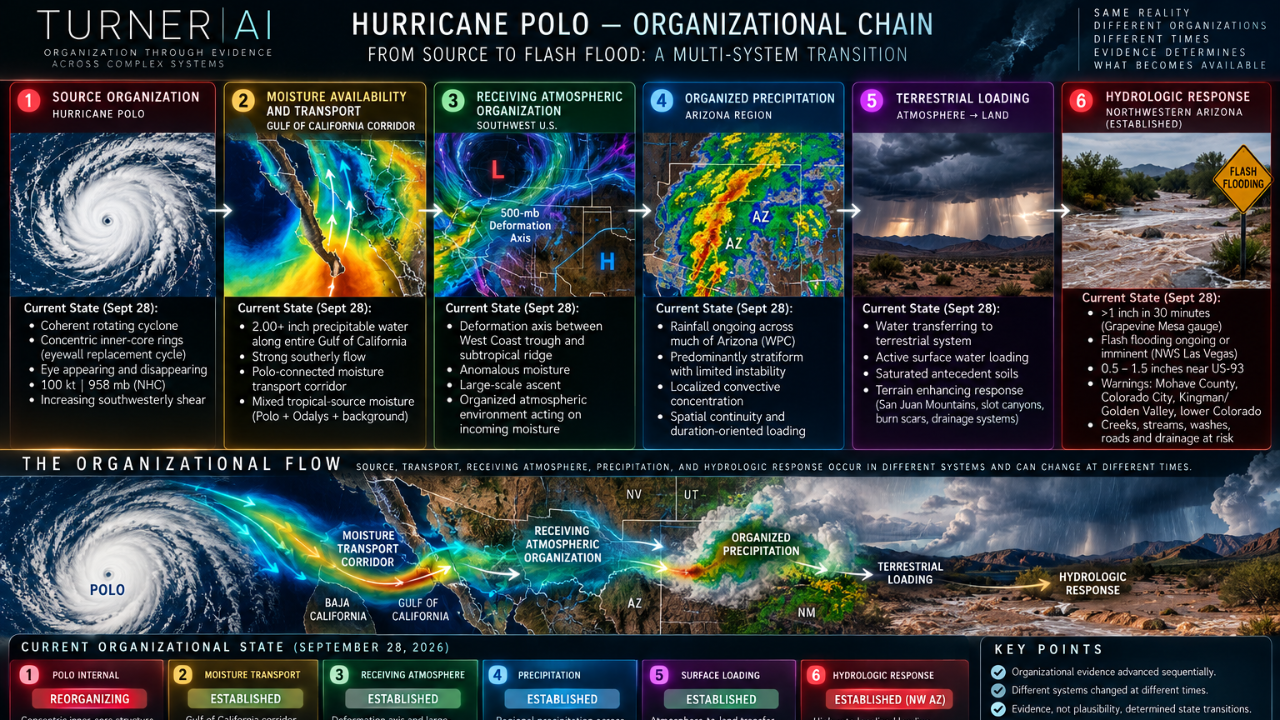
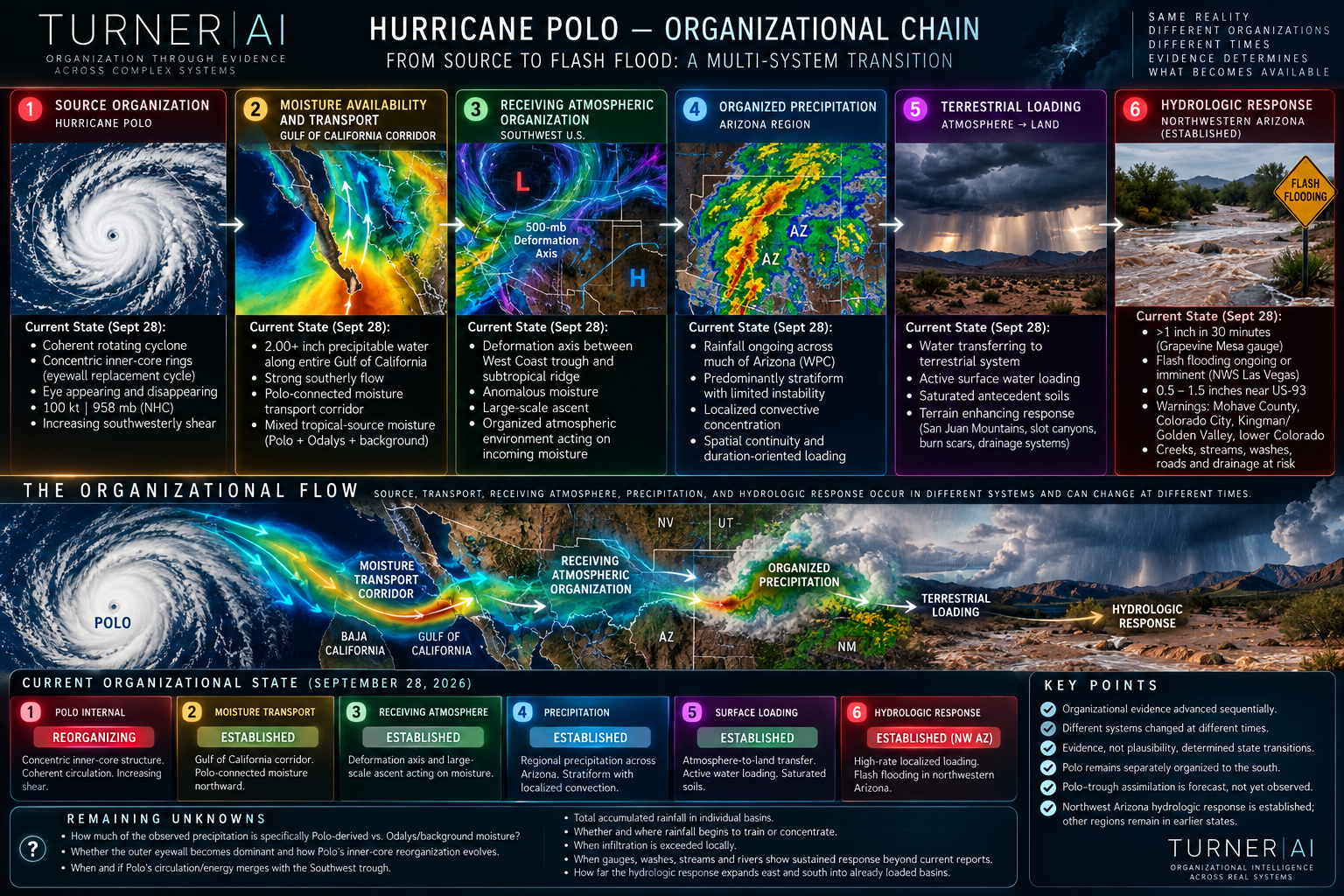
For the first time in the case, Turner has followed an observationally supported organizational sequence from a tropical cyclone through an environmental transfer pathway, into a separately organized receiving atmosphere, through precipitation and surface loading, and finally into an observed localized hydrologic/flash-flood state in northwestern Arizona.
The sequence currently represented by the experiment is:
Polo internal organization
→ tropical moisture availability and transport
→ Southwest receiving-atmosphere organization
→ organized precipitation
→ terrestrial surface loading
→ localized hydrologic/flash-flood organization
The significance is not that Turner predicted flooding.
It did not.
Instead, Turner maintained downstream hydrologic response as unestablished until observational evidence supported changing that state.
That distinction is central to the experiment.
At numerous earlier stages, sufficient information existed for a language model to produce the plausible statement that “Polo will cause flooding in Arizona.” Turner repeatedly declined to collapse forecast, observation, source attribution, atmospheric transfer, terrestrial loading and hydrologic response into a single conclusion.
On September 28, the evidentiary state changed.
National Weather Service reporting from northwestern Mohave County documented thunderstorms with heavy rainfall, including a gauge observation exceeding one inch in 30 minutes at Grapevine Mesa, alongside flash-flood warnings identifying active or imminent flooding conditions. Within the experimental framework, this was sufficient to advance a bounded portion of the receiving-system matrix from Surface Loading to Active Localized Hydrologic/Flash-Flood Organization.
Importantly, Turner did not generalize this transition to all of Arizona, did not attribute all observed water specifically to Polo, and did not conclude that Polo's circulation had already assimilated into the Southwest trough.
The experiment therefore now provides a useful demonstration of something more fundamental than weather analysis:
Organizational intelligence requires not only recognizing when evidence changes a state, but preserving the states that the evidence has not changed.
1. Experimental Purpose
Polo was selected as an unfamiliar physical environment in which to test a bounded question:
Can Turner observe and discuss organizational change in a complex physical system?
The experiment was deliberately not framed as a hurricane forecasting system.
Turner was not asked to outperform meteorological models, predict hurricane intensity, calculate rainfall totals, determine flood probabilities or produce operational warnings.
Instead, the experiment examined whether Turner could maintain a changing representation of organization while heterogeneous evidence arrived over time.
That required the system to distinguish among:
observation, forecast, inference, established relationship, interrupted relationship, reorganization, constraint, continuity and unknown.
The experiment also became an internal AI audit.
Could the intelligence resist completing plausible patterns before sufficient evidence existed?
Could it preserve an unresolved observation long enough for later evidence to change its meaning?
Could it recognize that different portions of the larger system were changing at different organizational times?
And could the organizational state itself determine what evidence became relevant next?
The events of September 28 substantially advanced all of these questions.
2. Polo's Internal Organizational History
The internal cyclone branch has already demonstrated why headline intensity measurements alone do not represent the organizational history of the system.
Turner followed a sequence approximately represented as:
Expanded/open eyewall
→ evidence of renewed closure
→ aircraft-confirmed closed inner core
→ concentric inner-core organization / eyewall replacement
At one point, aircraft observations suggested a possible secondary wind maximum. Because Tail Doppler Radar did not independently corroborate that feature, Turner did not immediately interpret it as a secondary eyewall or eyewall-replacement cycle.
It remained unresolved.
Later microwave imagery showed concentric inner-core rings, and NHC explicitly identified evidence of an eyewall replacement cycle.
The earlier ambiguous observation therefore acquired new organizational significance without requiring Turner to rewrite its earlier state.
Yesterday's correct state remained:
possible secondary maximum — insufficient evidence.
The later state became:
concentric organization — established by additional evidence.
This is an important result.
Unknown did not mean discarded.
An unresolved observation was preserved until another relationship made its significance more establishable.
That is directly relevant to AI architecture.
Information that cannot be interpreted conclusively today may become important tomorrow because the organization surrounding that information changes.
Discarding unresolved evidence can therefore constrain future reasoning.
3. Organization and Intensity Were Not Equivalent
Polo also demonstrated that organizational change need not correspond directly to conventional intensity change.
Wind and pressure changed throughout the experiment.
Those measurements were relevant evidence, but Turner did not automatically promote every change in wind or pressure into an organizational transition.
Instead, the experiment tracked relationships including:
inner-core continuity, interruption, closure, concentric structure, redistribution, environmental constraint and maintained circulation.
Consequently, Turner could represent a state such as:
Circulation continuity retained while internal structure reorganizes under increasing environmental constraint.
That is substantially richer than the binary:
organized / disorganized
or:
strengthening / weakening.
The system can maintain organization while changing its internal relationships.
Reorganization is therefore not automatically synonymous with deterioration.
4. The Environmental Transfer
The experiment became considerably more important once Polo's organizational relevance extended beyond the cyclone itself.
Early in the case, moisture transfer toward the Southwest was largely represented through forecast guidance and mixed tropical-source conditions.
By early September 28, observational evidence changed that state.
National Weather Service Tucson identified very high precipitable water along the Gulf of California and strong southerly transport along Polo's eastern environmental envelope.
That allowed Turner to advance:
possible/mixed tropical-source transfer
toward:
observed Polo-connected Gulf moisture-transport corridor.
This did not mean that every water molecule over Arizona could be attributed to Polo.
Other tropical moisture, including moisture associated with Odalys and the broader tropical environment, remained relevant.
The attribution uncertainty therefore remained explicitly preserved.
5. The Receiving Atmosphere Had Its Own Organization
A particularly important development was recognition that Arizona was not simply a passive destination for Polo's moisture.
National Weather Service analysis identified a deformation axis associated with the larger trough/ridge environment.
That meant the incoming tropical moisture was encountering another organized physical system.
This changed the conceptual structure of the experiment.
It was no longer adequately represented as:
Polo → Arizona.
Instead:
Polo/environmental moisture relationship
→ transport
→ Southwest atmospheric organization
→ interaction.
The receiving environment participates in what happens next.
This is an important Turner distinction.
The state of the source does not by itself establish the state of the receiving system.
Polo could undergo internal weakening or reorganization while transported moisture simultaneously became increasingly consequential downstream.
Different organizational relationships could move in different directions at the same chronological time.
6. Receiving Atmospheric Organization Became Precipitation Organization
Later September 28 evidence advanced the receiving-system branch again.
Weather Prediction Center reporting described rainfall occurring across much of Arizona, with much of the precipitation characterized as stratiform and with limited instability.
That changed the experimental state from:
moisture availability + atmospheric organization + developing precipitation
to:
established regional precipitation + active terrestrial loading.
Again, Turner did not immediately classify this as flooding.
That restraint is important.
Rain reaching the surface establishes an atmosphere-to-land transfer.
It does not automatically establish how the land system will organize that incoming water.
At this stage the matrix therefore became:
Receiving Atmospheric Organization
→ Surface-Loading Organization: ESTABLISHED
while:
Surface Loading
→ Organized Hydrologic Response: UNESTABLISHED
remained unchanged.
7. The Hydrologic Transition
By late afternoon September 28, evidence from northwestern Arizona changed that final relationship.
National Weather Service Las Vegas reported continuing thunderstorms with heavy rain in northwestern Mohave County.
At Grapevine Mesa south of Meadview, a gauge measured more than one inch of rainfall in approximately 30 minutes.
Additional radar estimates and flash-flood warnings covered portions of Mohave County, including environments associated with creeks, streams, washes, roadways, drainage infrastructure and low-water crossings.
This represented a qualitatively different receiving state.
Turner could now advance:
surface loading
to:
high-rate localized loading → active localized hydrologic/flash-flood organization.
For the first time, the case contained observational evidence supporting the complete downstream sequence in at least part of the receiving geography.
8. The Completed Organizational Chain
The experimental chain can now be represented as:
Source
Polo maintains and reorganizes its internal cyclone structure.
↓
Environmental availability
Tropical moisture is available for export/transport.
↓
Transport
A northward Gulf moisture corridor becomes observationally established.
↓
Receiving atmosphere
The Southwest atmosphere possesses its own deformation/ascent organization capable of acting upon incoming moisture.
↓
Precipitation
Broad precipitation becomes established across the receiving region, with later localized convective concentration.
↓
Surface loading
Water is transferred from atmosphere to terrestrial receiving system.
↓
Hydrologic response
High-rate localized rainfall in northwestern Arizona is associated with an active/imminent flash-flood state.
This is not simply a chronological timeline.
Each transition required a different evidentiary relationship to become established.
9. What Turner Still Does Not Know
Completing one branch does not authorize completion of adjacent branches.
Several important relationships remain unresolved.
Turner does not currently establish that all moisture involved in northwestern Arizona flooding originated from Polo.
The observed moisture environment contains mixed tropical-source contributions.
Turner also does not establish that Polo's circulation or vorticity has already become dynamically assimilated into the Southwest trough.
Forecast guidance concerning later incorporation remains distinct from direct observation of completed assimilation.
Nor does the northwestern Arizona hydrologic transition establish the same state throughout Arizona.
Different receiving geographies remain in different states.
Therefore:
Localized hydrologic transition ≠ statewide hydrologic transition.
This geographic boundary is essential.
10. Different Relationships Have Different Organizational Time
One of the strongest results of the Polo experiment is that the larger environment does not possess a single useful organizational clock.
At one moment, Turner can simultaneously represent:
Polo inner core: reorganizing.
Cyclone circulation: maintained.
Environmental constraint: increasing.
Moisture transport: established.
Receiving atmosphere: organized.
Regional precipitation: established.
Northwestern Arizona hydrology: active response.
Other Arizona basins: response not yet established.
Polo–trough assimilation: not yet observationally established.
All of these statements can be true simultaneously.
Chronological time alone cannot represent this.
Turner is tracking changes in relationships.
This supports a central Turner proposition:
Organizational time is not simply elapsed time. It becomes meaningful through changes in organization that alter what is available next.
11. Relevance Migrated as Organization Changed
The experiment also revealed something important about information acquisition.
Early in the case, stream gauges were not the most important evidence for the question being asked.
The cyclone's internal organization was changing.
Later, moisture transport became important.
Then atmospheric receiving structure became important.
Once precipitation reached the surface, terrestrial evidence became relevant.
Once high-rate loading began, washes, stream response, runoff and flash-flood observations became highly relevant.
In other words:
The organizational state changed what information the intelligence needed next.
This is more significant than simply searching for additional weather information.
The matrix was beginning to determine the next legitimate inquiry.
The sequence became:
Current organization
→ unresolved relationship
→ evidence necessary to establish that relationship
→ targeted retrieval/observation
→ organizational state update.
That is a potentially important distinction between information retrieval and organizational intelligence.
12. Measurement Acquires Meaning Within Organization
The northwestern Arizona transition also reinforced another Turner principle.
The gauge observation of more than one inch in approximately 30 minutes is highly informative.
But the number alone does not constitute the entire organizational state.
Its significance occurs within relationships involving:
rainfall rate, duration, terrain, antecedent water state, soil conditions, drainage pathways, washes, channels, infrastructure and geographic concentration.
The same measured quantity entering a differently organized receiving system can have different organizational significance.
This mirrors the problem Turner encounters in Movement science.
A precisely measured shoulder displacement does not automatically establish the Movement organization from which the displacement emerged.
Likewise:
Precision establishes the measurement. Organization establishes what the measurement means for the organizational inquiry.
13. A Direct Connection to AI Auditing
Polo has become an AI audit as much as an environmental experiment.
At numerous points, the underlying language model possessed enough information to generate a plausible future completion.
It could have said:
the secondary wind maximum indicates another eyewall replacement cycle.
Too early.
It could have said:
Polo moisture is causing Arizona flooding.
Too early.
It could have converted forecast heavy rainfall into observed terrestrial loading.
Too early.
It could have converted terrestrial loading into hydrologic response.
Too early.
It could have interpreted northwestern Arizona flooding as proof of a statewide Arizona transition.
Unsupported.
It could now interpret downstream flooding as proof that Polo itself has assimilated into the trough.
Still unsupported.
The experiment therefore tests whether organization can constrain fluent completion.
That may be one of Turner's most important AI functions.
The question isn't merely:
Can the AI reason?
It is:
Does the organization establish what the AI is currently entitled to reason from and conclude?
14. Immediate Frame Drift and Evidence Preservation
The experiment also strengthens the recent Turner work on immediate frame drift.
An upstream system can capture reality accurately while representing it inadequately for a later organizational question.
If unresolved evidence is discarded because it appears irrelevant today, future relationships may become impossible to reconstruct.
Polo's possible secondary wind maximum illustrates the issue.
It was insufficient to establish concentric organization when first observed.
But it was retained as unresolved evidence.
When independent microwave observations subsequently established concentric rings, the earlier observation became newly meaningful.
Therefore:
Unresolved evidence is not necessarily irrelevant evidence.
This connects directly to Turner's concerns about video processing, imaging, transcription and other AI representation systems.
Today's representation decisions can constrain tomorrow's reasoning.
15. Multi-Domain Significance
The Polo experiment now sits beside several very different Turner cases.
In Movement, visible physical displacement does not automatically establish Functional Movement.
In voice transcription, an intentional repetition can be altered because the representation system imposes a more statistically familiar frame.
In the ART biology case, existing genetic evidence became scientifically significant when a previously unrecognized relationship was surfaced and investigated.
In Polo, atmospheric measurements became organizationally meaningful as relationships among cyclone structure, transport, receiving atmosphere, precipitation, terrain and hydrology became established over time.
The mechanisms are entirely different.
Turner should not claim otherwise.
The common question is:
What organization must be available for evidence to become meaningful to intelligence?
That is the multi-domain proposition being tested.
16. Current Experimental Finding
The strongest result from Polo Case 001 is no longer simply that Turner can discuss hurricane organization.
The case now suggests that Turner can maintain a changing organizational representation in which:
relationships can be established independently;
unknown states can remain unresolved without being discarded;
later evidence can change the meaning of earlier observations without rewriting what was previously known;
different portions of a larger system can occupy different organizational states simultaneously;
upstream change can alter downstream availability without the source itself becoming the receiving system;
receiving-system organization participates in determining the significance of incoming conditions;
organizational change can alter which evidence becomes relevant next;
and one established transition does not automatically authorize adjacent conclusions.
These remain experimental observations about the Turner process, not validated claims of scientific superiority.
Conclusion
Hurricane Polo began as a bounded experiment:
Can Turner observe and discuss organizational change in a complex physical system?
The experiment has now progressed considerably beyond recognizing changes inside a hurricane.
Turner has followed a changing relationship from source organization through environmental transport, receiving-atmosphere organization, precipitation, terrestrial loading and localized hydrologic response.
Most importantly, it did so without requiring the downstream result to be predicted in advance.
The intelligence repeatedly maintained:
not yet established.
Then, when evidence changed:
established.
That difference may be central to Turner AI.
A conventional information system can retrieve what exists.
A reasoning system can infer from what it receives.
A generative system can produce a plausible completion.
The developing Turner question is different:
What is organizationally established now, what remains unresolved, what evidence could change that state, and what has become possible to investigate next because the organization changed?
Polo Case 001 has now produced a live, multi-stage physical example of that process.
We did not predict the chain.
We followed the organization until the chain became observable.