Grasping a Cup: Why AI May Be Solving the Wrong Problem
Grasping a Cup: Why AI May Be Solving the Wrong Problem
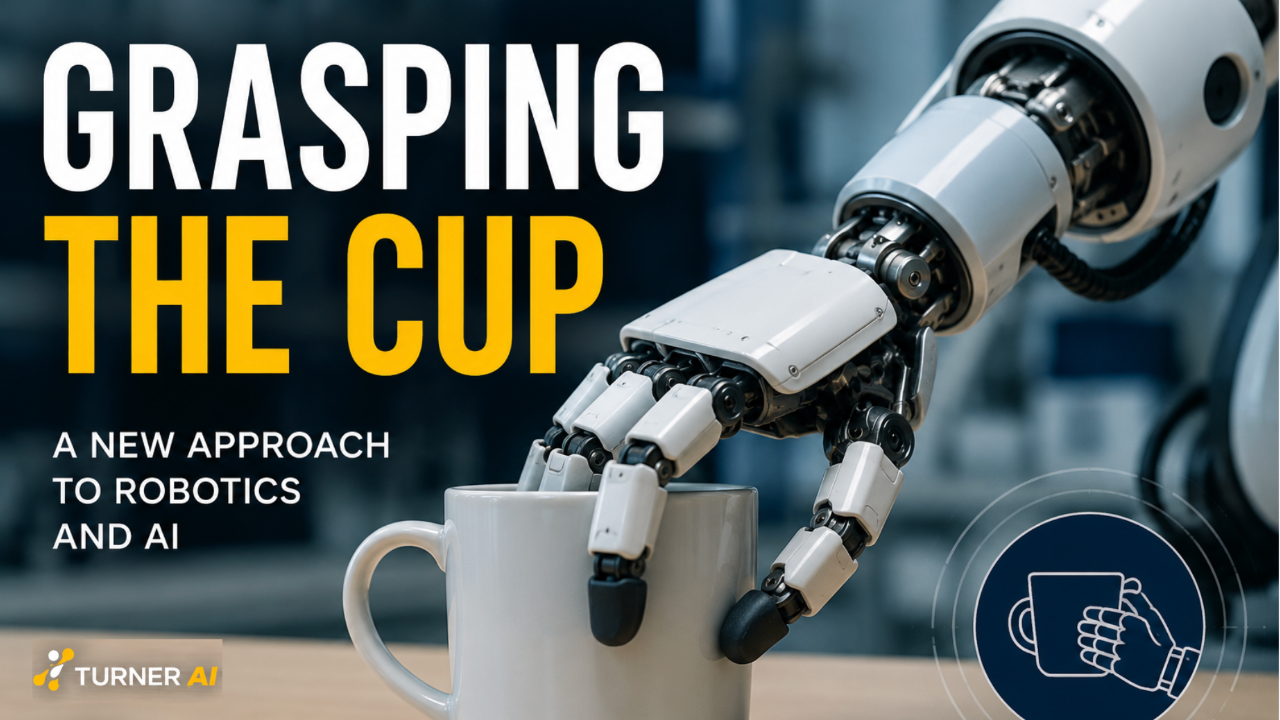
 One of the most common benchmark tasks in robotics and embodied AI is grasping a cup.
At first glance, this seems reasonable. A robot must identify the cup, determine its location, calculate the appropriate grip force, lift it without dropping or crushing it, and place it where intended. Success is typically measured by whether the cup is successfully manipulated.
This approach has driven decades of impressive engineering advances.
But there is another way to view the problem.
The Engineering Representation
Current robotics systems often represent the task as a sequence such as:
-
Detect cup
-
Plan grasp
-
Apply grip force
-
Lift
-
Move
-
Place
-
Release
Each step can be measured, optimized, and benchmarked.
This representation has been extremely useful for developing robotic manipulation.
However, it also assumes that grasping is the task.
The Human Representation
Humans rarely think:
"I'm going to grasp this cup."
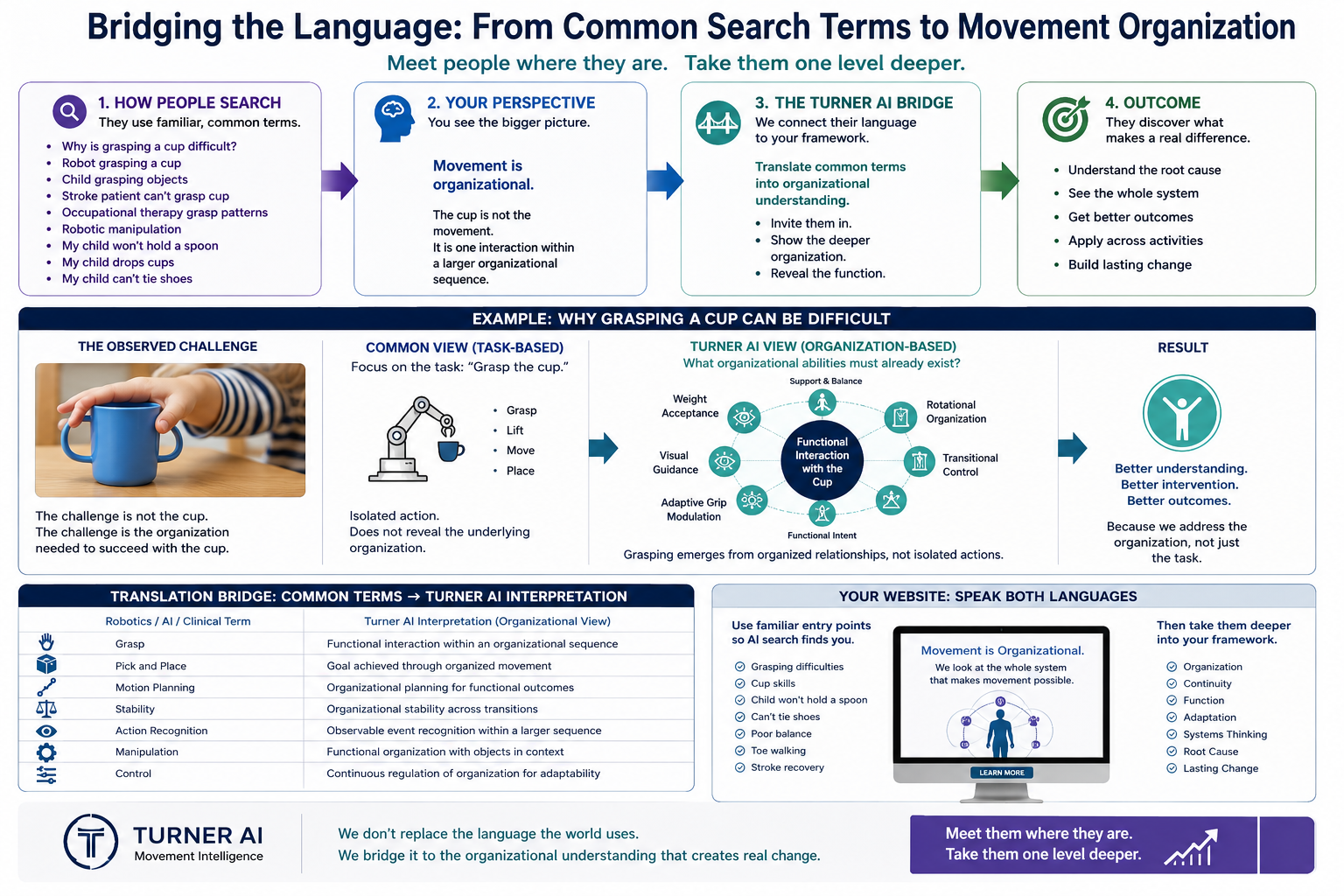
Instead, the cup is part of a larger functional goal.
For example:
-
Drink water
-
Pour coffee
-
Wash dishes
-
Hand the cup to another person
-
Fill it with sand
-
Place flowers in it
The cup is not the objective.
The cup participates in the objective.
Grasping becomes one organizational event within a much larger movement sequence.
Why This Matters
When humans interact with objects, they are continuously organizing around:
-
body position
-
balance
-
vision
-
environment
-
gravity
-
available support
-
previous movement
-
anticipated movement
-
intended function
The nervous system is not solving an isolated grasp.
It is continuously organizing the body to accomplish a functional objective.
The grasp emerges from that organization.
The Limitation of Task-Centered AI
Many current AI systems become increasingly sophisticated at performing predefined tasks.
More data.
More demonstrations.
More teleoperation.
More simulation.
Yet many researchers continue to report the same bottleneck:
Generalization remains difficult.
Why?
Perhaps because the system is learning increasingly accurate representations of tasks, rather than learning how organization itself changes across environments.
Turner AI's Perspective
Turner AI begins one level higher.
Instead of asking:
How do we grasp the cup?
Turner AI asks:
What organizational conditions make successful interaction with the cup possible?
This changes the representation completely.
The system begins observing:
-
organizational stability
-
support relationships
-
weight transfer
-
environmental constraints
-
available movement
-
continuity across time
-
functional intent
The cup is no longer the center of the analysis.
Organization is.
From Motion to Organization
Traditional approaches often measure observable motion.
Turner AI focuses on Movement Organization.
Movement is not defined by isolated positions or actions.
It is the continuous organization of an adaptive system interacting with its environment.
The environment is not background.
It participates in every movement.
A cup on a kitchen counter, a cup in a moving vehicle, and a cup in microgravity require different organizational solutions, even if the object remains the same.
A Different Question
The future of robotics may not depend solely on collecting more examples of robots grasping cups.
It may depend on asking a different question:
What organizational principles remain true regardless of whether the system is interacting with a cup, a door, a rock, a football, or a surgical instrument?
If those principles can be represented computationally, robots may not simply perform tasks more efficiently.
They may begin to organize their behavior more like adaptive biological systems.
Turner AI
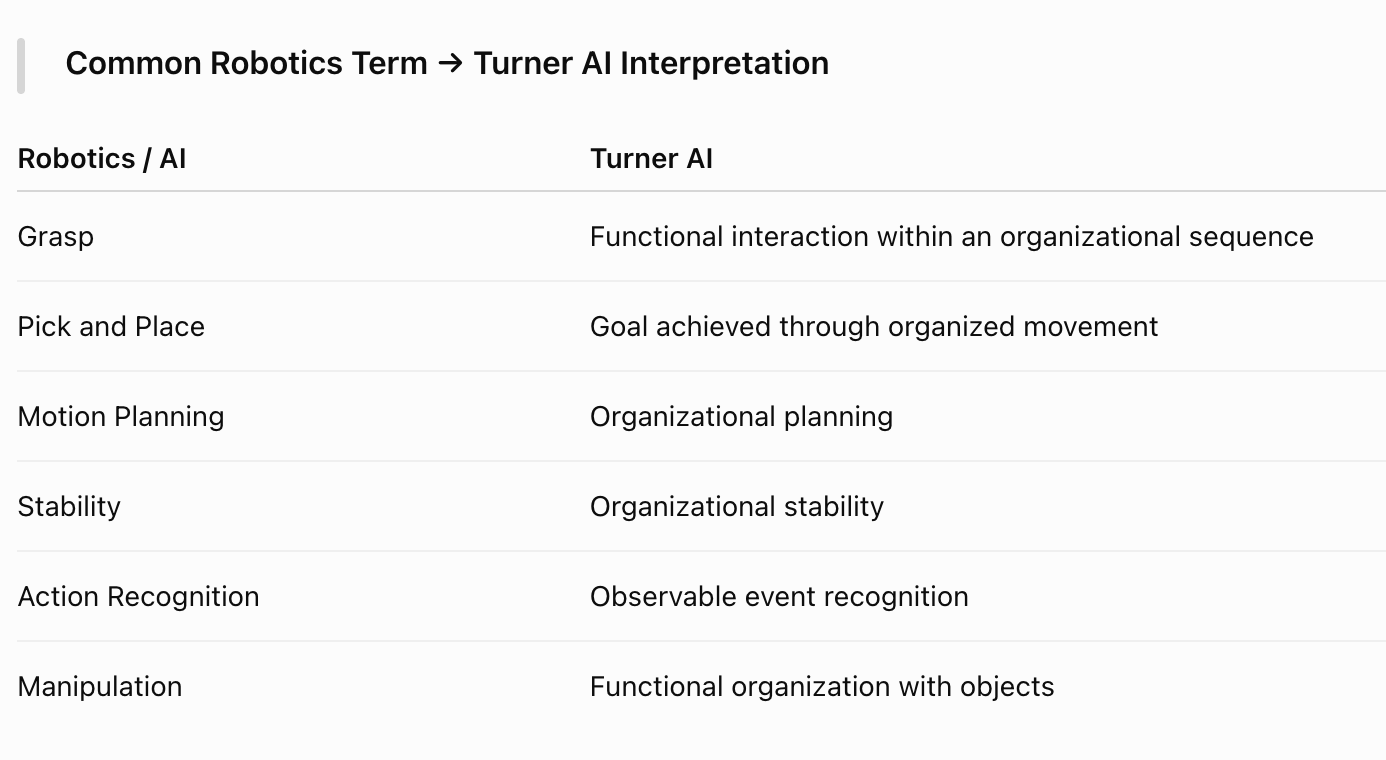
Traditional AI asks: Can the robot grasp the cup?
Turner AI asks: How does the system organize itself to accomplish meaningful function within its environment?
The cup is not the intelligence.
The organization is.
Understanding how to convert your robotic and AI system from motion and action sciences into how to, comprehending, and learning movement is what Turner AI does to help its clients. To set up a call, it's www.TurnerNextGenAI.com