Grasping a Cup: Why AI May Be Solving the Wrong Problem
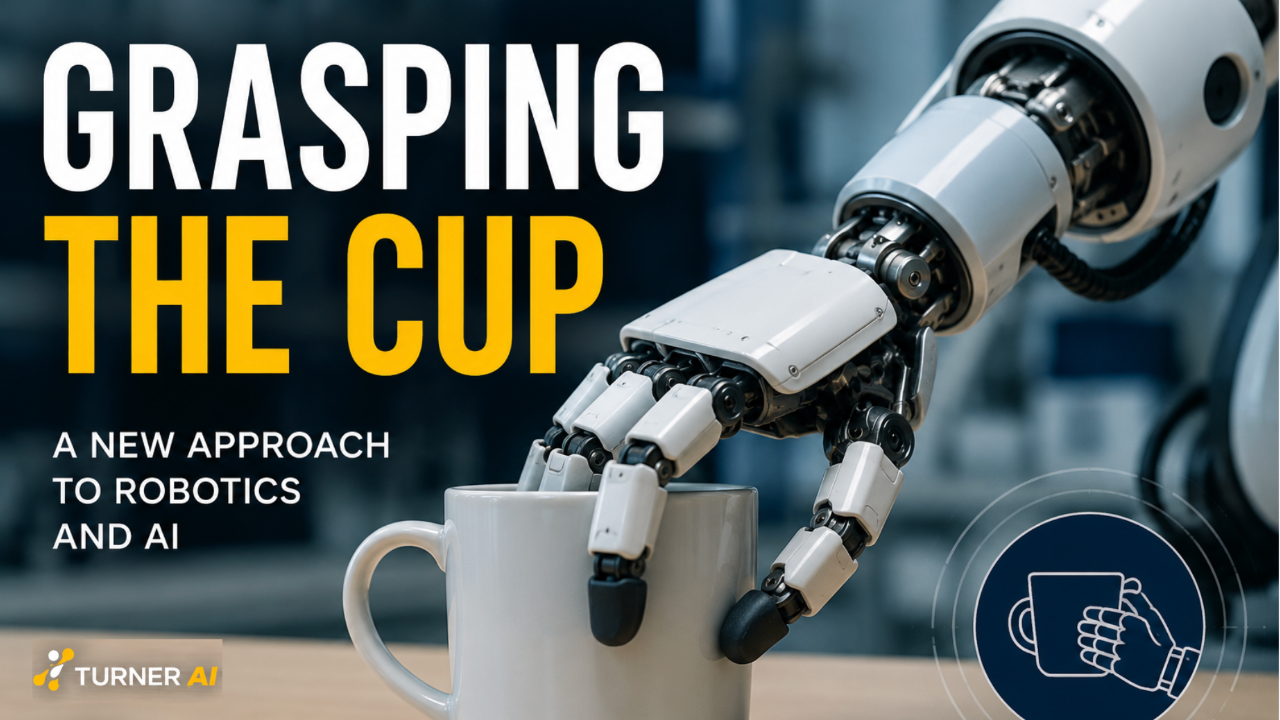
Grasping a Cup: Why AI May Be Solving the Wrong Problem
 One of the most common benchmark tasks in robotics and embodied AI is grasping a cup.
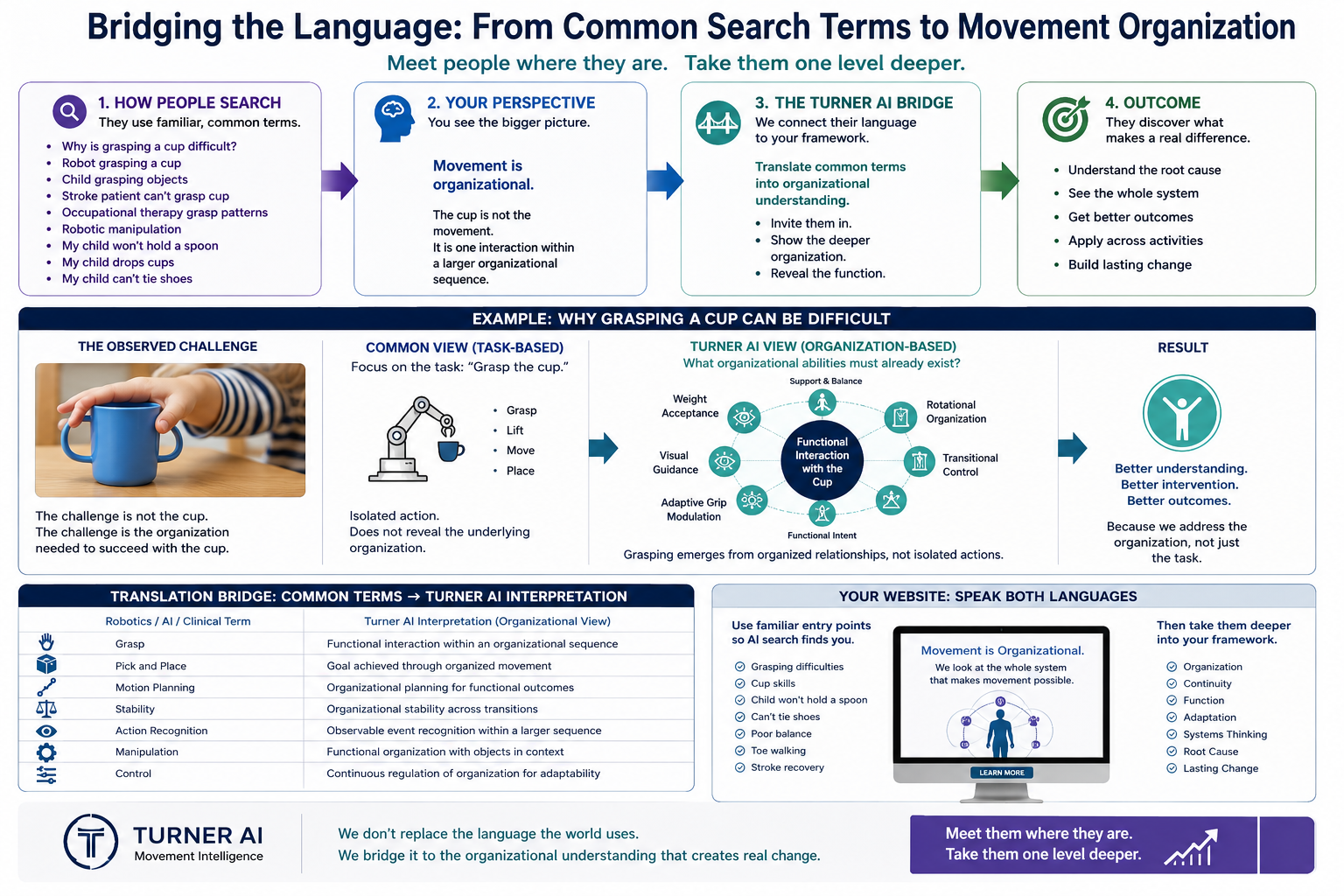
At first glance, this seems reasonable. A robot must identify the cup, determine its location, calculate the appropriate grip force, lift it without dropping or crushing it, and place it where intended. Success is typically measured by whether the cup is successfully manipulated.
This approach has driven decades of impressive engineering advances.
But there is another way to view the problem.
The Engineering Representation
Current robotics systems often represent the task as a sequence such as:
-
Detect cup
-
Plan grasp
-
Apply grip force
-
Lift
-
Move
-
Place
-
Release
Each step can be measured, optimized, and benchmarked.
This representation has been extremely useful for developing robotic manipulation.
However, it also assumes that grasping is the task.
The Human Representation
Humans rarely think:
"
...
Turner AI: Beyond Pattern Recognition—Computing Organizational Intelligence
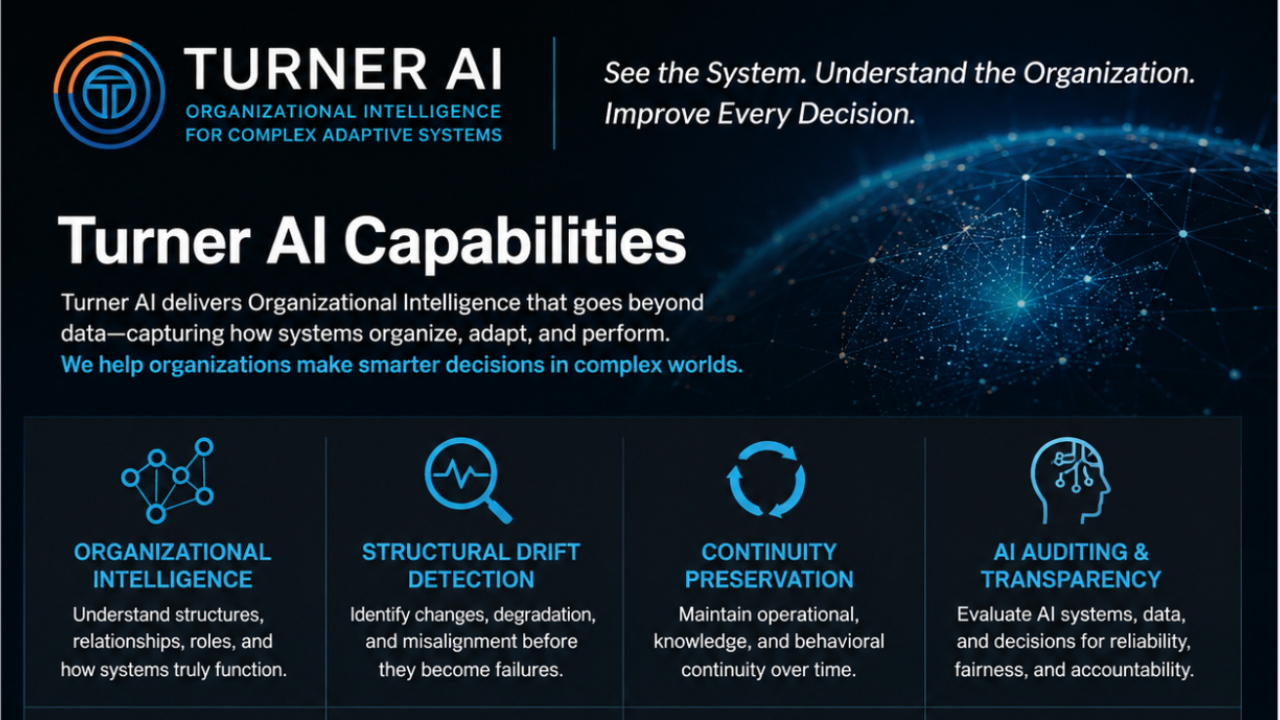
Turner AI: Beyond Pattern Recognition—Computing Organizational Intelligence
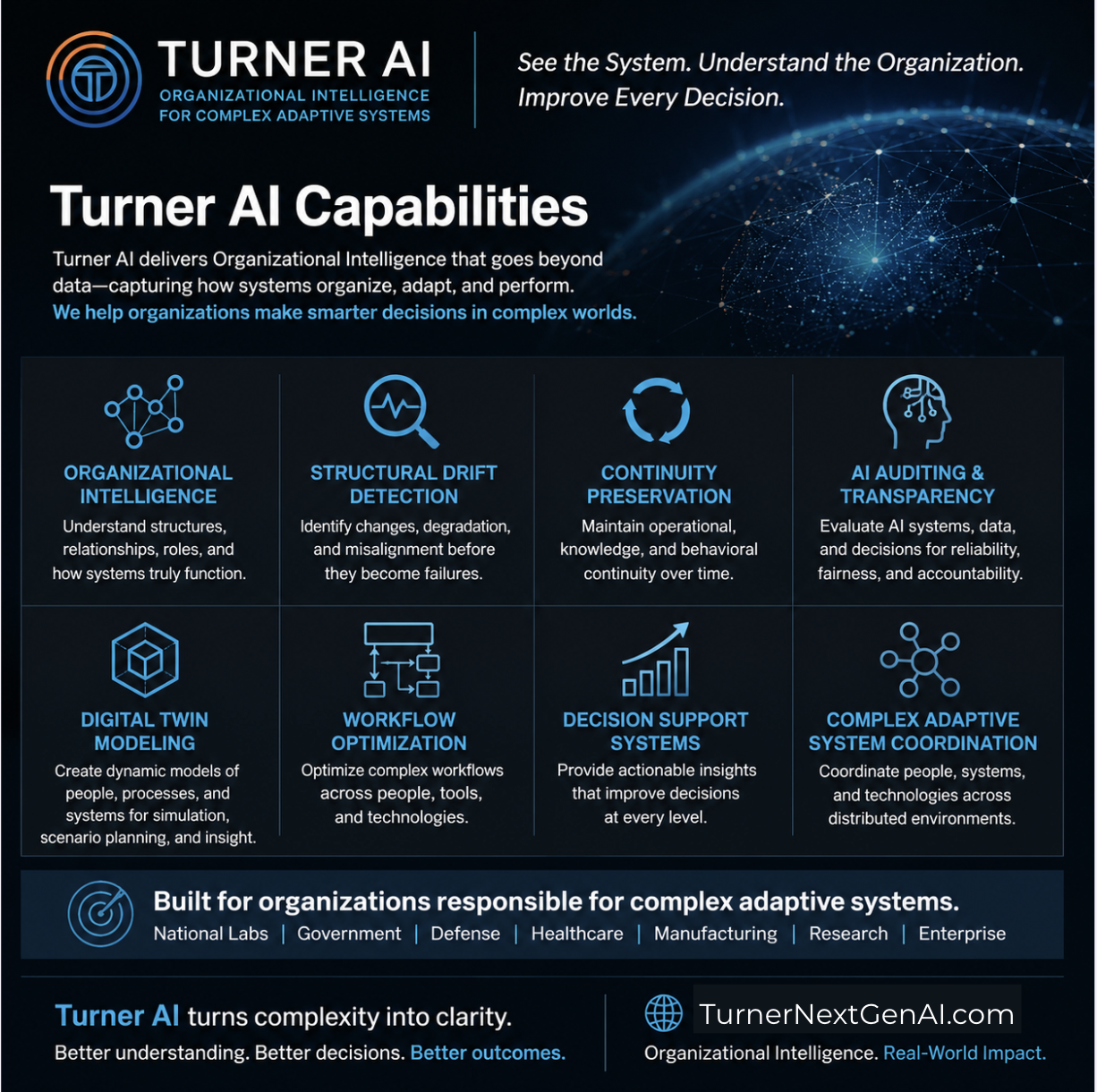
Artificial intelligence has made remarkable advances in recognizing patterns. From computer vision to large language models, today's AI excels at identifying what has happened, classifying observations, and predicting likely outcomes from existing data.
But many of the world's most important problems are not limited by pattern recognition.
They are limited by understanding how complex systems organize themselves.
That distinction is at the heart of Turner AI.
For decades, industries have relied on increasingly sophisticated methods to analyze outputs. In manufacturing, systems monitor production metrics. In healthcare, clinicians evaluate patient outcomes. In robotics, cameras track movement. In enterprise software, AI optimizes individual components. Yet across these domains, a common challenge remains: current systems often optimize local performance while struggling to understand the organizational...
Agents Are Not Intelligence: Why the AI Industry May Be Solving the Wrong Problem
Turner NextGen AI
The artificial intelligence industry has entered what appears to be the "Age of Agents."
Every major technology company is now promoting:
-
AI Agents
-
Autonomous Agents
-
Personal Agents
-
Enterprise Agents
-
Multi-Agent Systems
The promise is simple:
An agent will schedule meetings, answer emails, coordinate tasks, manage workflows, interact with software, and eventually act on behalf of the user.
While these capabilities may provide substantial value, they raise an important question:
Are we building intelligence, or are we building automation?
The distinction matters.
Because the future of AI may depend on understanding the difference.
The Current Agent Explosion
Over the past several years, artificial intelligence has made enormous advances in:
-
language generation
-
coding
-
summarization
-
search
-
image generation
However, progress toward Artificial General Intelligence (AGI) has proven far more difficult ...
Turner AI Pre-Orbit Evaluation Report

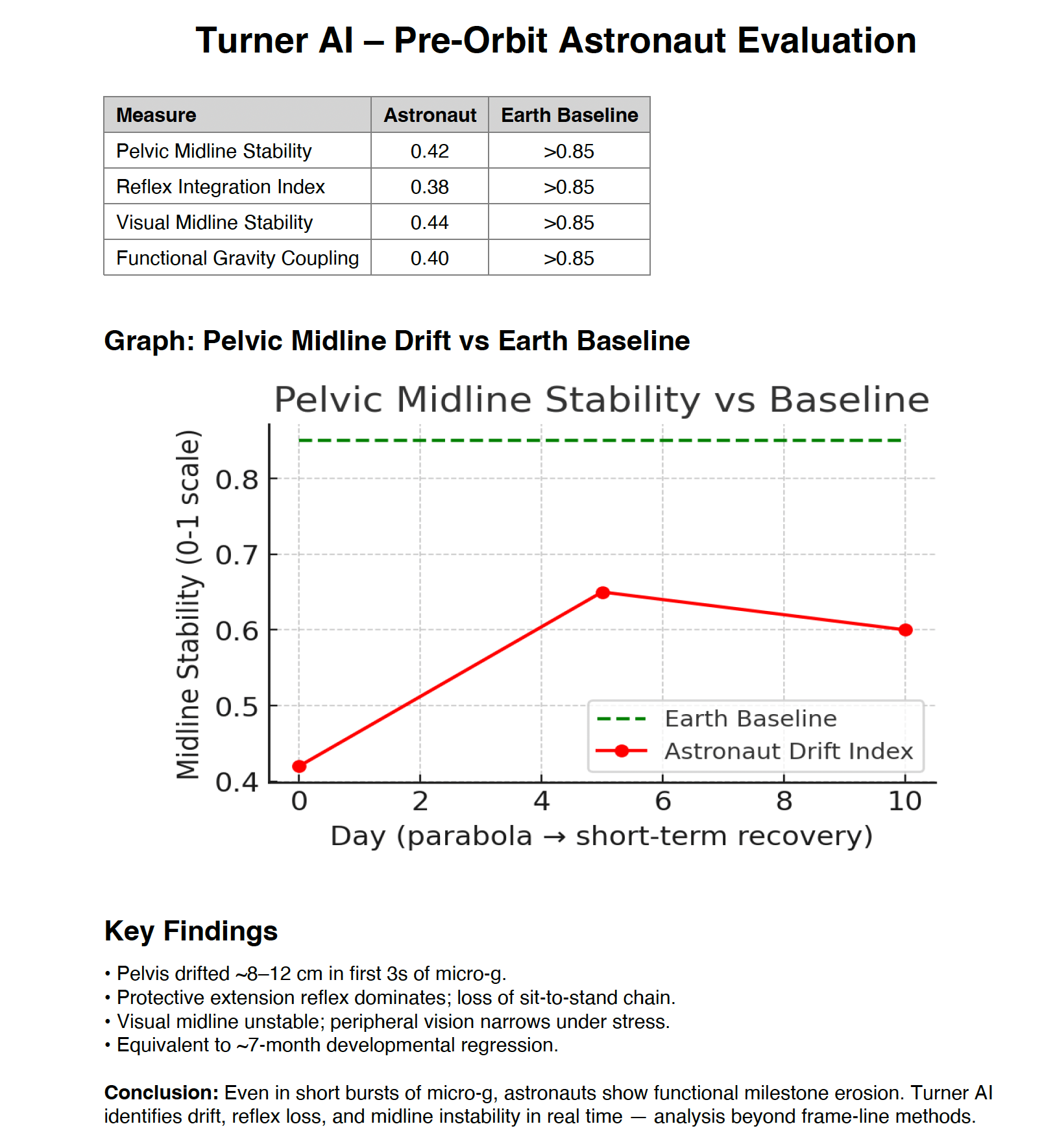
Turner AI – Pre-Orbit Structural Evaluation
Subject: Astronaut training on NASA 747 parabolic flight (micro-g, ~20s burst)
Context: Pre-orbit simulation to capture functional drift under microgravity conditions.
 Frame Analysis Findings
1. Pelvic Stability & Midline Drift
-
Pelvis fails to maintain central rotational axis → ~8–12 cm drift observed within 3s.
-
Lack of skeletal buoyancy → counter-torque shifts load to upper limbs.
-
Indicates compromised gait lift → poor transition baseline for orbital milestones.
2. Reflex Integration
-
Protective extension reflex dominates (arms extended forward).
-
Absence of righting reflex in pelvis → indicates suppressed counterbalance loop.
-
Functional milestone loss: “sitting to standing” reflex not accessible in micro-g.
3. Visual Midline & Peripheral Stability
-
Head tilt inconsistent, helmet does not stabilize gaze.
-
Eyes and cervical column show decoupling from pelvis.
-
Predictable outcome: reduced
...