Turner AI: Beyond Pattern Recognition—Computing Organizational Intelligence
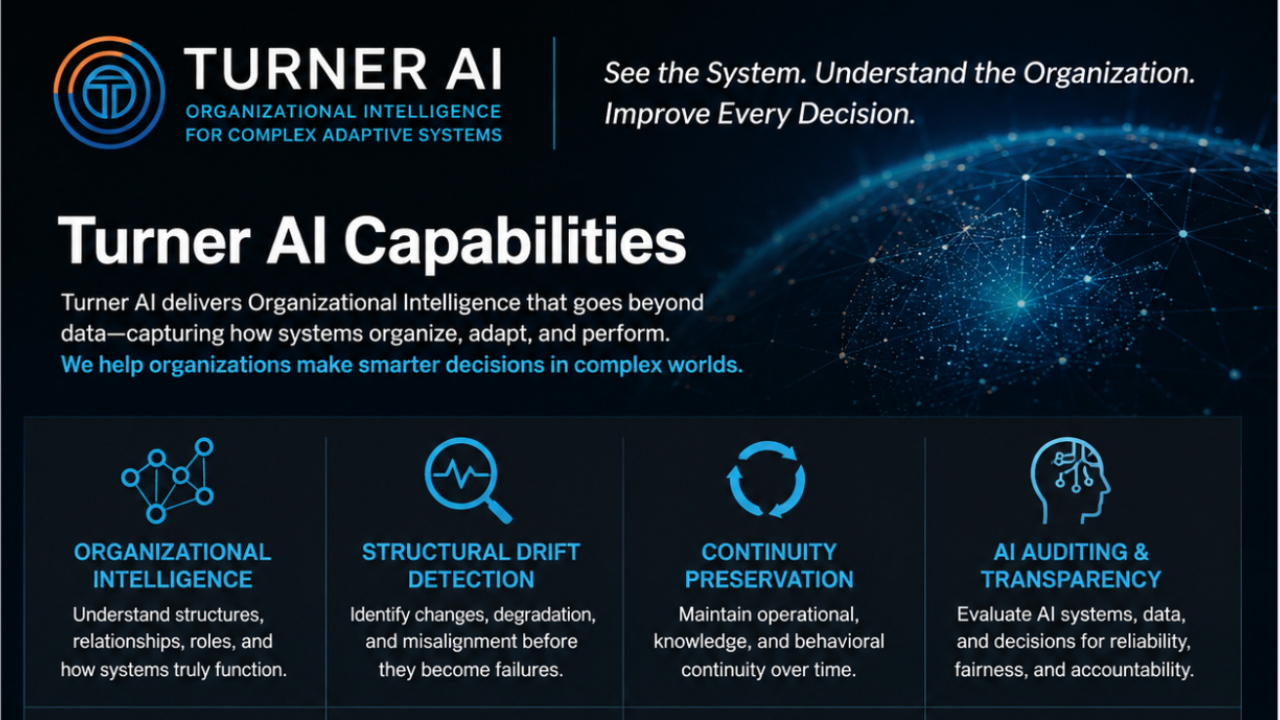
Turner AI: Beyond Pattern Recognition—Computing Organizational Intelligence
Artificial intelligence has made remarkable advances in recognizing patterns. From computer vision to large language models, today's AI excels at identifying what has happened, classifying observations, and predicting likely outcomes from existing data.
But many of the world's most important problems are not limited by pattern recognition.
They are limited by understanding how complex systems organize themselves.
That distinction is at the heart of Turner AI.
For decades, industries have relied on increasingly sophisticated methods to analyze outputs. In manufacturing, systems monitor production metrics. In healthcare, clinicians evaluate patient outcomes. In robotics, cameras track movement. In enterprise software, AI optimizes individual components. Yet across these domains, a common challenge remains: current systems often optimize local performance while struggling to understand the organizational relationships that produce system-wide behavior. This distinction emerged repeatedly through customer discovery interviews conducted across government, healthcare, enterprise software, and research communities.
Moving Beyond Motion
Most video analysis systems begin with detecting motion.
Turner AI begins by asking a different question:
How is the system organizing itself?
Rather than simply measuring movement, Turner AI evaluates structural relationships, force organization, continuity, adaptation, and the interaction between components. The goal is not merely to identify patterns, but to understand the organizational framework that gives rise to those patterns.
This shift allows computational analysis to move from describing motion toward interpreting function.
Organizational Intelligence
The core capability of Turner AI is Organizational Intelligence.
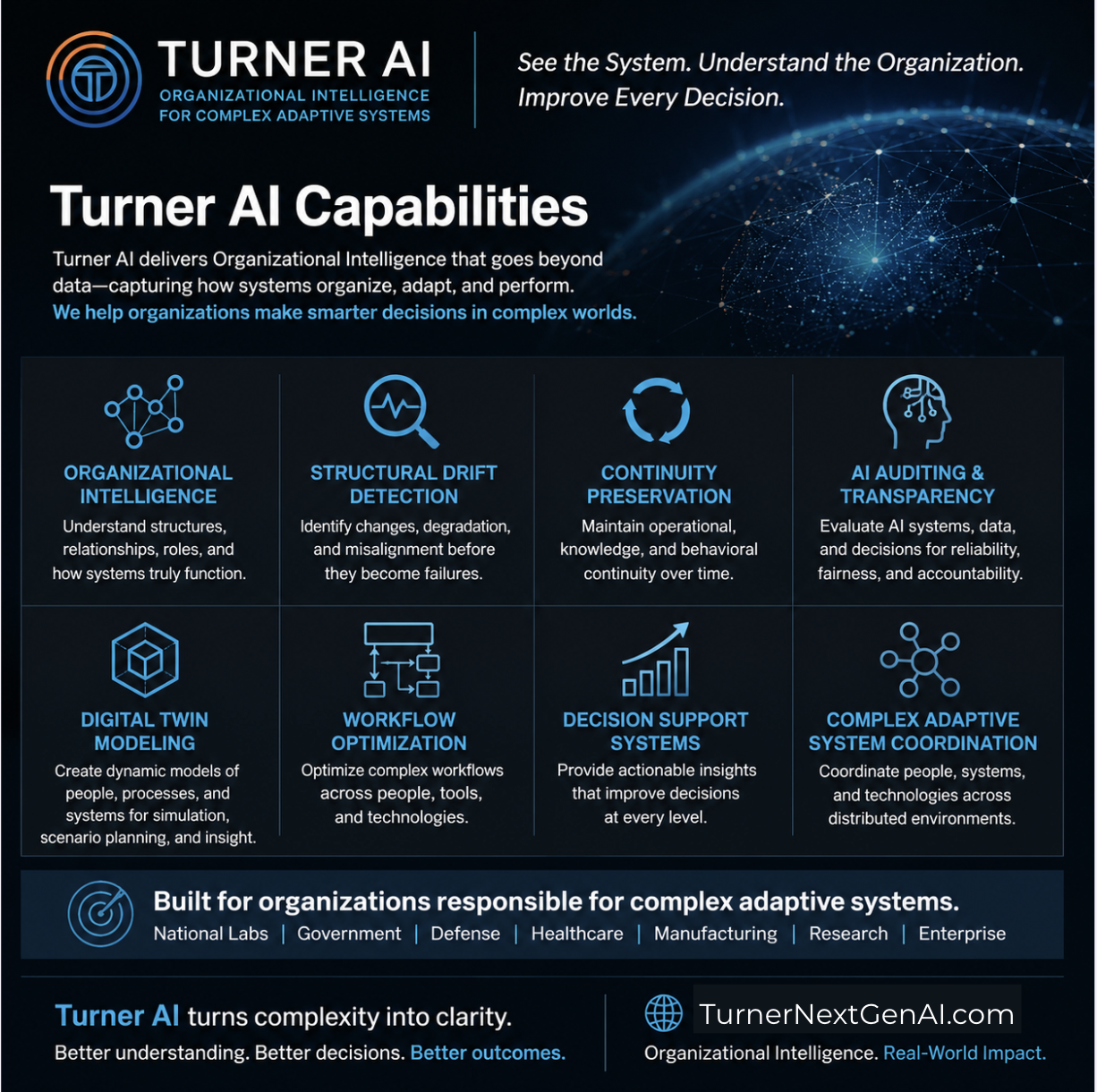
Organizational Intelligence represents a computational framework for analyzing how complex adaptive systems organize, adapt, compensate, and maintain continuity over time.
This enables capabilities including:
-
Organizational structure analysis
-
Structural drift detection
-
Continuity preservation
-
AI auditing
-
Digital twin enhancement
-
Decision support
-
Complex adaptive system coordination
Instead of treating data as isolated observations, Turner AI evaluates relationships across the system as a whole.
Representation Before Computation
One of the recurring themes identified during commercialization interviews was that many AI systems successfully optimize existing representations but struggle when the underlying representation does not capture the organizational relationships that matter. Enterprise software engineers, healthcare leaders, and systems researchers independently described challenges involving architecture, coordination, context, and system-level reasoning rather than isolated component optimization.
This insight reinforces an important principle:
Better computation begins with better representation.
If the computational model does not accurately represent how a system organizes itself, increasingly powerful algorithms may simply optimize an incomplete picture.
From Local Optimization to System Understanding
Traditional AI often asks:
-
What pattern occurred?
-
What prediction is most likely?
-
Which component should be optimized?
Turner AI extends those questions by asking:
-
How are resources organized?
-
Where is structural drift beginning?
-
How is continuity being maintained?
-
What organizational relationships are changing?
-
What is the system-wide cost of achieving current performance?
These questions become increasingly important as organizations depend on AI to support high-consequence decisions.
Applications Across Complex Systems
Because organizational principles exist across many domains, Turner AI is designed for environments where system-level understanding matters more than isolated optimization.
Potential applications include:
-
Advanced manufacturing
-
National laboratories
-
Digital twins
-
Robotics
-
Healthcare systems
-
Enterprise operations
-
Aerospace
-
Infrastructure
-
Research environments
The common denominator is not the industry.
It is the presence of complex adaptive systems whose performance depends on organizational integrity.
The Next Generation of AI
The future of AI will not depend solely on larger models or faster computation.
It will increasingly depend on richer computational representations of how systems organize, adapt, and evolve.
Pattern recognition remains essential.
But for many of society's most complex problems, recognizing patterns is only the beginning.
Understanding organization is the next layer.
Turner AI is building that computational framework.
"Most systems analyze what a system does. Turner AI analyzes how the system organizes itself." This reflects the broader architecture you've developed over decades—an integrated framework focused on organizational perception, continuity, compensation, and system integrity rather than isolated outputs.