Hurricane Polo and Its Turner AI Tracker
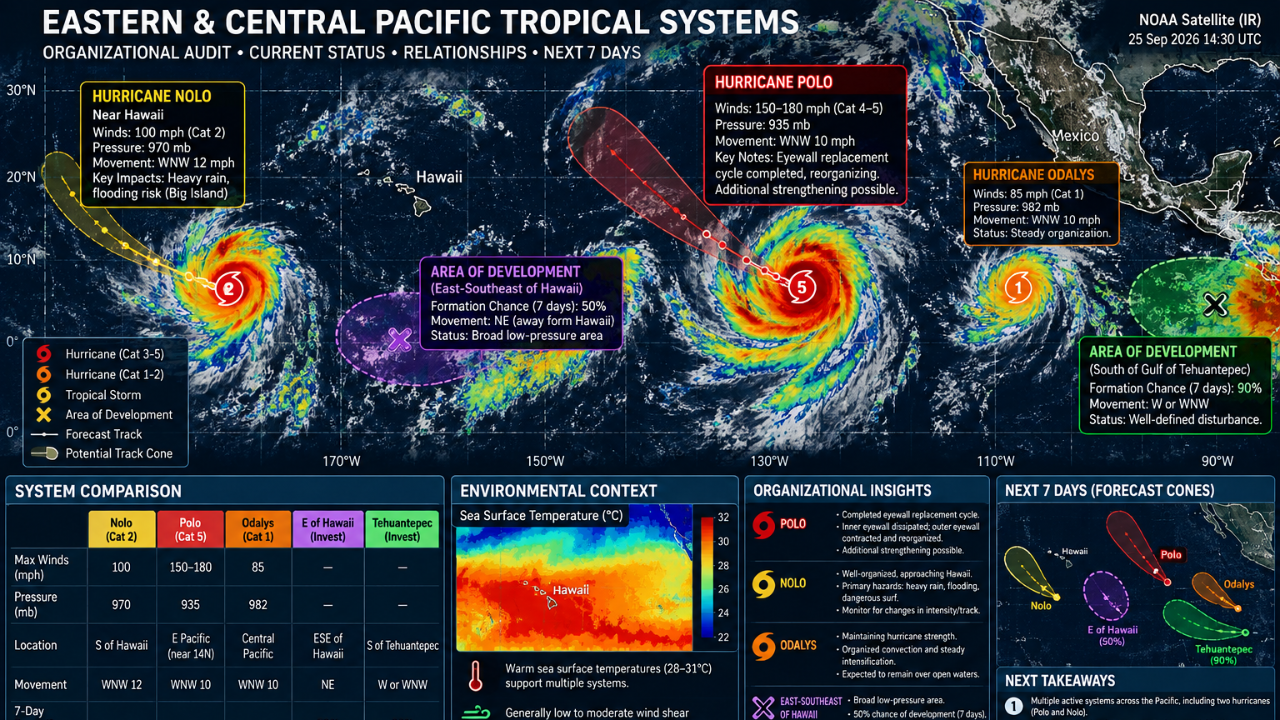
Turner AI Organizational Audit Report
Eastern & Central Pacific Tropical Systems — Hurricane Polo and the Surrounding Pacific Environment
Audit Date: September 25, 2026
Audit Type: Environmental Organization / Dynamic-System Case Study
Primary Focus: Hurricane Polo, Hurricane Nolo, and the surrounding tropical-development environment
Executive Summary
The current Pacific tropical environment provides an unusually valuable Turner AI case study because the scientifically interesting feature is not simply that multiple storms exist simultaneously, nor that Hurricane Polo has reached extreme intensity. The stronger question is how organization is being established, maintained, disrupted, transferred, and re-established across changing environmental conditions.
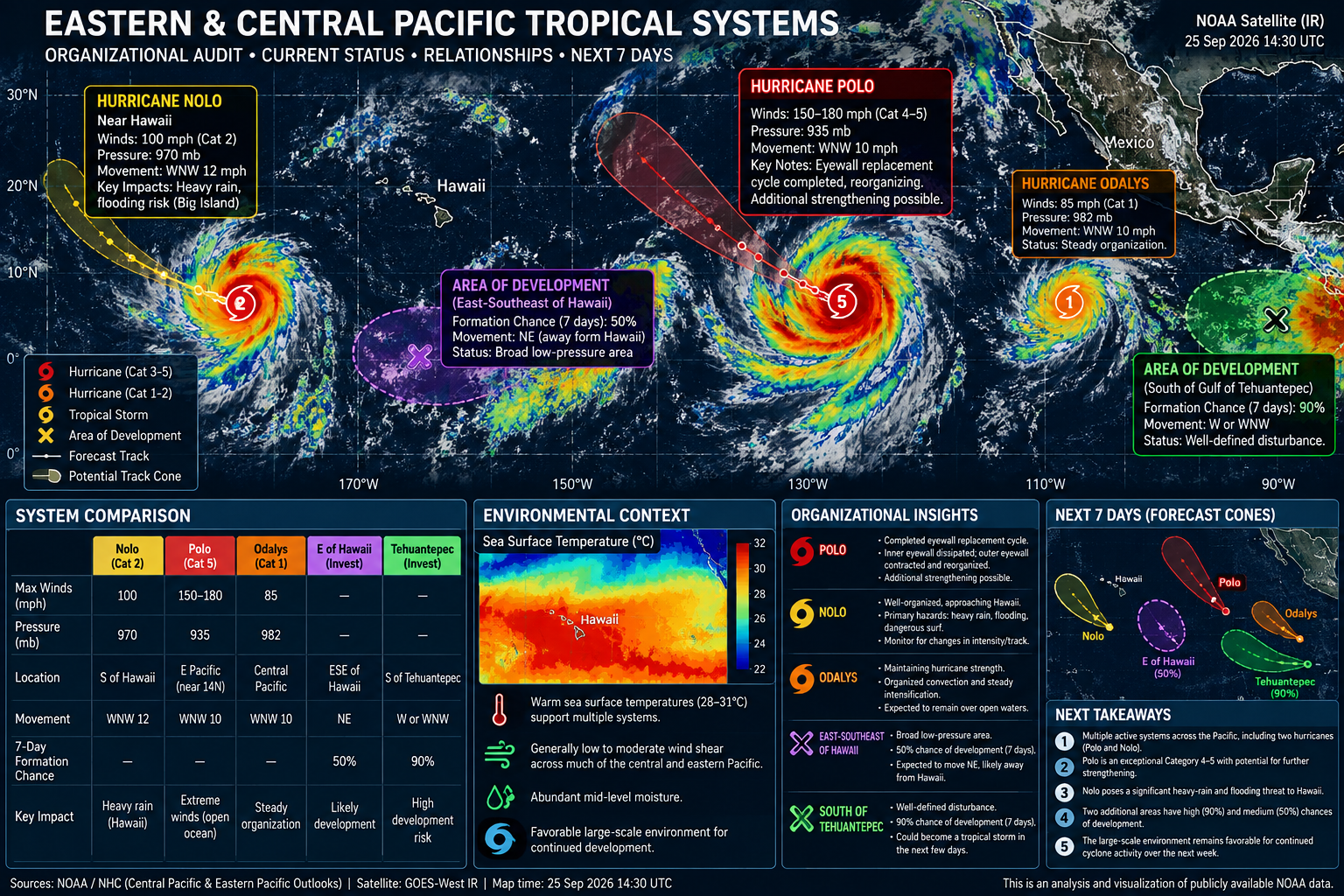
Current NOAA/NHC information shows several simultaneous tropical systems and development areas across the Eastern and Central Pacific. Hurricane Polo has undergone significant internal structural change, including an eyewall replacement cycle followed by renewed organization and intensification. Hurricane Nolo is positioned south of Hawaii, while other active or developing systems occupy the broader Pacific environment.
The Turner audit therefore does not begin with wind speed, storm category, pressure, satellite appearance, or forecast track. Those are observations and measurements of the system. They become meaningful to Turner when their relationships establish something about organizational state, change, continuity, deviation, recovery, and future availability.
The central finding from this preliminary audit is that Polo presents a particularly strong natural example of a system undergoing substantial internal change without necessarily losing organizational continuity. Its eyewall replacement sequence provides an observable transition from one organization through disruption and into a newly established organization capable of supporting subsequent intensification.
That distinction opens a larger Turner research question:
Can the organizational state of a complex environmental system establish what subsequent states are becoming available before those states are fully expressed as conventional outcomes?
This report does not claim that Turner predicts hurricanes or improves meteorological forecasting. It identifies an organizational-science problem that can be investigated using meteorological evidence.
1. Audit Boundary
The first requirement is to establish the environment correctly.
It would be a mistake to define the audit as simply:
Hurricane Polo
Polo exists within a larger environmental organization. The appropriate preliminary boundary is therefore:
Pacific environmental conditions → developing systems → organized tropical cyclones → internal storm organization → structural transitions → environmental interaction → resulting organizational states
This does not mean that Polo, Nolo, Odalys, and the other disturbances are causally organizing one another. Current evidence does not establish that.
Their simultaneous existence instead gives us evidence about a larger Pacific environment presently capable of supporting multiple organized tropical systems.
This is an important Turner distinction:
Coexistence is observable. Relationship must be established. Causality cannot be assumed.
2. Polo: Measurement Versus Organization
The headline surrounding Polo is its extreme intensity.
That matters meteorologically, but from the Turner perspective, 180 mph is a measurement of an expressed state.
It does not by itself explain the organization producing that state.
Satellite imagery provides additional observable information: eye definition, cloud structure, convection, symmetry, surrounding environmental conditions and change through time.
Again, however:
Observation ≠ organization.
The particularly important event is Polo's documented eyewall replacement process.
NOAA hurricane reconnaissance identified concentric eyewalls. The inner eyewall subsequently dissipated while the outer eyewall contracted. Polo then reorganized and subsequently intensified again.
That sequence provides considerably more organizational information than a single maximum-wind measurement.
Conceptually:
Established organization
→ competing/changing internal structure
→ transition
→ loss of previous structure
→ redistribution/reorganization
→ establishment of new structure
→ renewed intensification becomes available
This is where Polo becomes scientifically valuable to Turner.
3. Organizational Continuity
A conventional description might say that Polo underwent an eyewall replacement cycle.
Turner asks another question:
What remained organizationally available throughout that transition that allowed the storm to reorganize?
That question matters because disruption and failure are not equivalent.
A system can undergo significant internal change while preserving enough organizational continuity to establish another viable state.
That is already fundamental within Turner.
The important variable may therefore not simply be whether organization changed. The important information may be the relationship between what changed and what remained available during the change.
Polo offers an opportunity to examine:
Organization → Transition → Availability → Reorganization
rather than merely:
Category 4 → Category 5
Those are fundamentally different representations of the same physical event.
4. The Environment Participates in the Organization
A hurricane cannot be organizationally interpreted as an isolated object.
Its environment participates in what becomes possible.
Meteorologists already observe and model factors such as atmospheric pressure, moisture, wind shear, ocean temperature, steering patterns, convection and upper-level outflow. Turner should not replace that science.
Nor should Turner assume every measurable environmental variable is organizationally relevant simply because the measurement exists.
Instead, the organizational inquiry becomes:
Which environmental relationships are participating in maintaining, constraining, disrupting or enabling the system's organization?
That changes the analytical structure.
Rather than treating environmental measurements as independent variables on a dashboard, Turner can investigate their relationships to changes in organizational state.
The resulting architecture becomes:
Environment
↓
Available conditions
↓
Storm organization
↓
Structural transition
↓
Organizational response
↓
Resulting state
↓
New availability
This introduces an important temporal distinction as well.
Chronological time tells us when the eyewall changed.
Organizational time asks:
What changed such that something different became possible?
5. Nolo and the Larger Pacific Environment
The simultaneous presence of Hurricane Nolo south of Hawaii makes the larger environmental picture particularly useful.
We should resist the temptation to interpret the Pacific as a collection of independent icons on a hurricane map.
Instead, the environment can itself become an audit subject.
The inquiry changes from:
How many storms are present?
to:
What organization of the Pacific environment is presently supporting the formation, maintenance, transition or deterioration of these systems?
That does not mean there is one simple environmental cause.
It means that Turner can begin looking for organization across scale.
For example:
Large environmental organization
↳ Regional environmental conditions
↳ Tropical disturbance organization
↳ Cyclone organization
↳ Internal cyclone organization
↳ Eyewall organization
↳ Local transition
That nested structure is much closer to Turner than treating every hurricane as an independent detected object.
6. State Is More Than Description
One of the strongest Turner implications from Polo concerns availability.
A system's current organization constrains what can happen next.
That does not mean current organization deterministically predicts one future outcome.
Instead, it changes the field of available possibilities.
Polo therefore allows us to investigate:
Current organizational state → available subsequent states
rather than:
Current measurement → predicted measurement
That distinction is substantial.
Meteorological forecasting may predict wind speed, pressure, track and intensity.
Turner's research question could instead become whether organizational analysis can establish:
what the system currently has available to it.
Strengthening may be available.
Maintenance may be available.
Structural reorganization may be available.
Weakening may become increasingly constrained or increasingly likely under another organization.
But Turner should not assign those possibilities merely from intuition. The organizational relationships producing availability would have to be established.
7. Deviation Is Not Necessarily Failure
Polo also gives us an excellent example of another Turner principle.
A deviation from one organizational state does not automatically represent deterioration.
An eyewall replacement can temporarily disrupt the existing organization while participating in establishment of another organization.
Therefore:
Change ≠ failure.
And:
Instability ≠ collapse.
The more useful questions are:
What changed?
What remained available?
What became unavailable?
What reorganized?
What relationship replaced the previous relationship?
What became possible afterward?
That is exactly the type of distinction conventional outcome-centered analytics can obscure.
8. From Hurricane Science to Environmental Interaction
There is another research direction here that reaches beyond meteorology.
Eventually, Turner does not necessarily need to stop at understanding the organization of the storm.
A hurricane interacts with other organized systems:
electrical grids
buildings
roads
communications infrastructure
transportation systems
water systems
coastlines
human operations
The conventional question might be:
What wind speed will this transformer experience?
Turner potentially adds:
What is the organizational state of the hurricane, what is the organizational state of the infrastructure, and what becomes possible when those two organizations interact?
That is considerably more difficult.
But it is also potentially considerably more valuable.
The eventual unit of inquiry becomes:
System A organization × System B organization × environmental conditions → interaction → deviation → propagation → response → recovery or failure
This is where the earlier Turner work around storms, physical systems and infrastructure becomes important again.
9. Epistemic Audit
Turner must remain disciplined about what the evidence establishes.
At this stage we can observe meteorological measurements, structural changes documented by NOAA, satellite imagery, reconnaissance observations, environmental measurements and subsequent storm behavior.
We cannot yet claim that Turner has established a new hurricane-prediction methodology.
We also cannot claim that the simultaneous tropical systems are causally related simply because they occupy the same broader Pacific environment.
And we should not claim that organizational state predicts intensification until an explicit Turner matrix has been built and tested against historical and prospective storm sequences.
That uncertainty is not a weakness of the audit.
It is part of the audit.
Known → inferred → hypothesized → unknown must remain separate.
10. Proposed Turner Research Matrix
Polo gives us a natural starting dataset:
Environmental organization → cyclone organization → internal structural organization → transition → deviation → continuity → reorganization → resulting state → subsequent availability
The next scientific step would not be to throw hundreds of meteorological variables into machine learning and ask it to predict hurricane intensity.
That would return us to conventional data-first reasoning.
Instead, we would establish the organizational question first and determine which evidence is required to answer it.
The first matrix should investigate relationships among:
Optimal/established organization → changing organization → deterioration or transition → compensation/reorganization → recovery/new organization
Then we determine which meteorological observations actually establish those states.
That preserves Turner architecture.
Audit Finding
Hurricane Polo is scientifically interesting to Turner not because it reached an extraordinary wind speed, but because it provides observable evidence of a complex natural system undergoing significant internal structural change while retaining or re-establishing sufficient organization for subsequent extreme performance.
That gives us a natural laboratory for one of Turner's central questions:
What does the current organization of a system make available next?
Polo gives us something unusually valuable because nature is performing the experiment for us.
We have an established system.
We have environmental conditions.
We have structural change.
We have disruption.
We have reorganization.
We have subsequent state change.
And we have extensive external instrumentation observing the process.
That means we don't need Turner to become a weather sensor.
The sensors already exist.
The opportunity is to determine whether Turner can extract a different class of information from what those sensors observe:
not merely what the hurricane is doing, but how its organization is changing, what it is preserving, what it is losing, how it reorganizes, and what that resulting organization makes possible next.
That is the experiment I would preserve from Hurricane Polo.