Turner AI for Wearable Systems
Organizational Intelligence for Real-Time Physical Environments
Executive Technical Thesis
Turner AI: An Organizational Intelligence Architecture for Wearable and Physical-World Systems
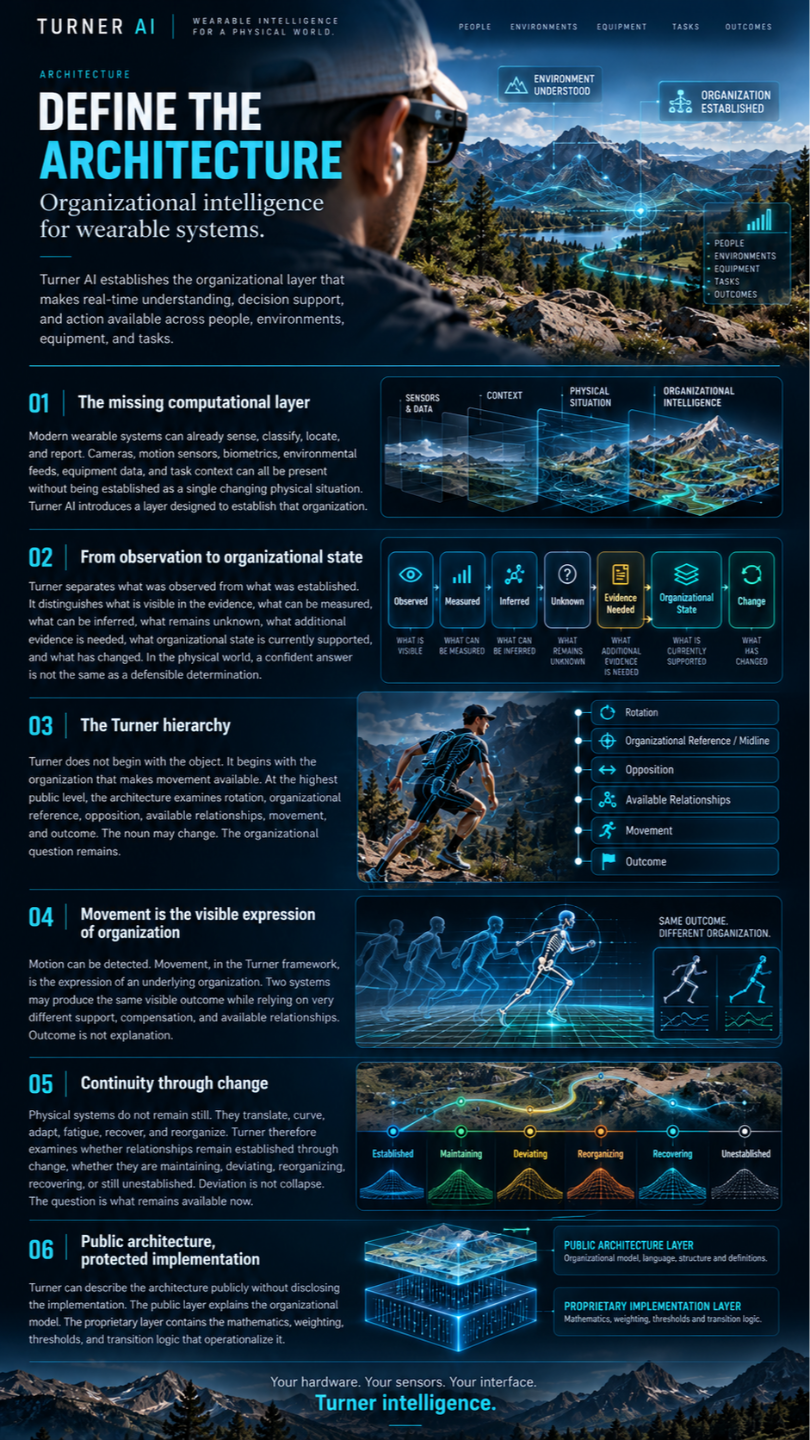
Wearable systems have advanced rapidly in sensing, perception, spatial awareness, biometrics, environmental monitoring, and generative interaction, yet these capabilities often remain fragmented across independent data streams and task-specific outputs. Turner AI proposes an organizational intelligence architecture intended to address this gap by establishing relationships among observations rather than treating each measurement as an isolated signal. The framework distinguishes what is directly observed, what is measured, what may be inferred, what remains unknown, and what additional evidence is required before a defensible determination can be made. From this evidence structure, Turner evaluates organizational state, change, and the relationships that remain available as physical conditions evolve.
The architecture is grounded in a movement-derived hierarchy in which rotation, organizational reference or midline, opposition, available relationships, Movement, and outcome are treated as linked organizational constructs rather than independent descriptors. Within this framework, Movement is not synonymous with motion; it is treated as the visible expression of underlying organization. Turner therefore focuses not only on what a system does, but on the organization that made an outcome possible, how that organization changes, and whether previously available relationships are maintained, lost, reorganized, or recovered over time.
The Level Needed for Applies Sciences
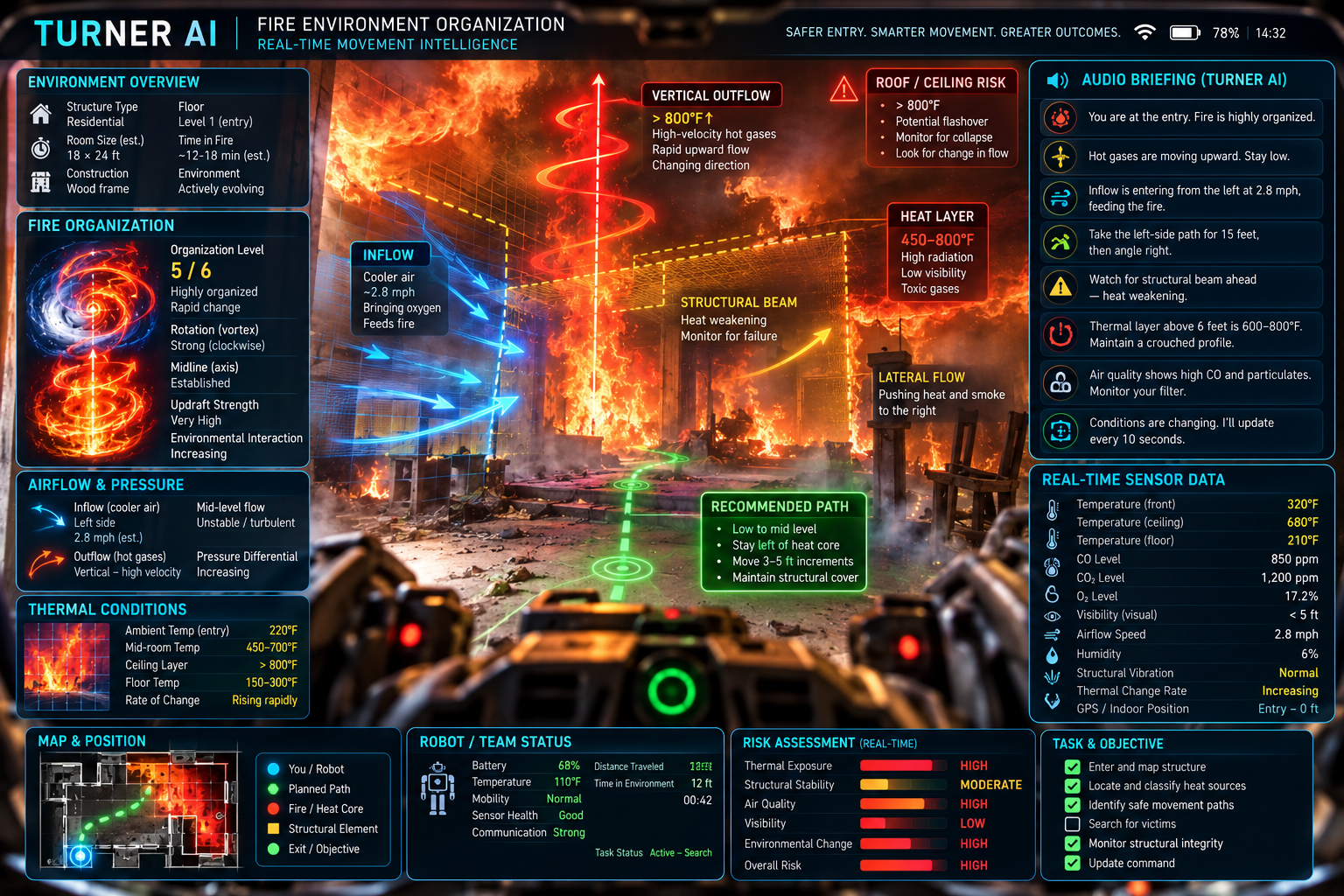
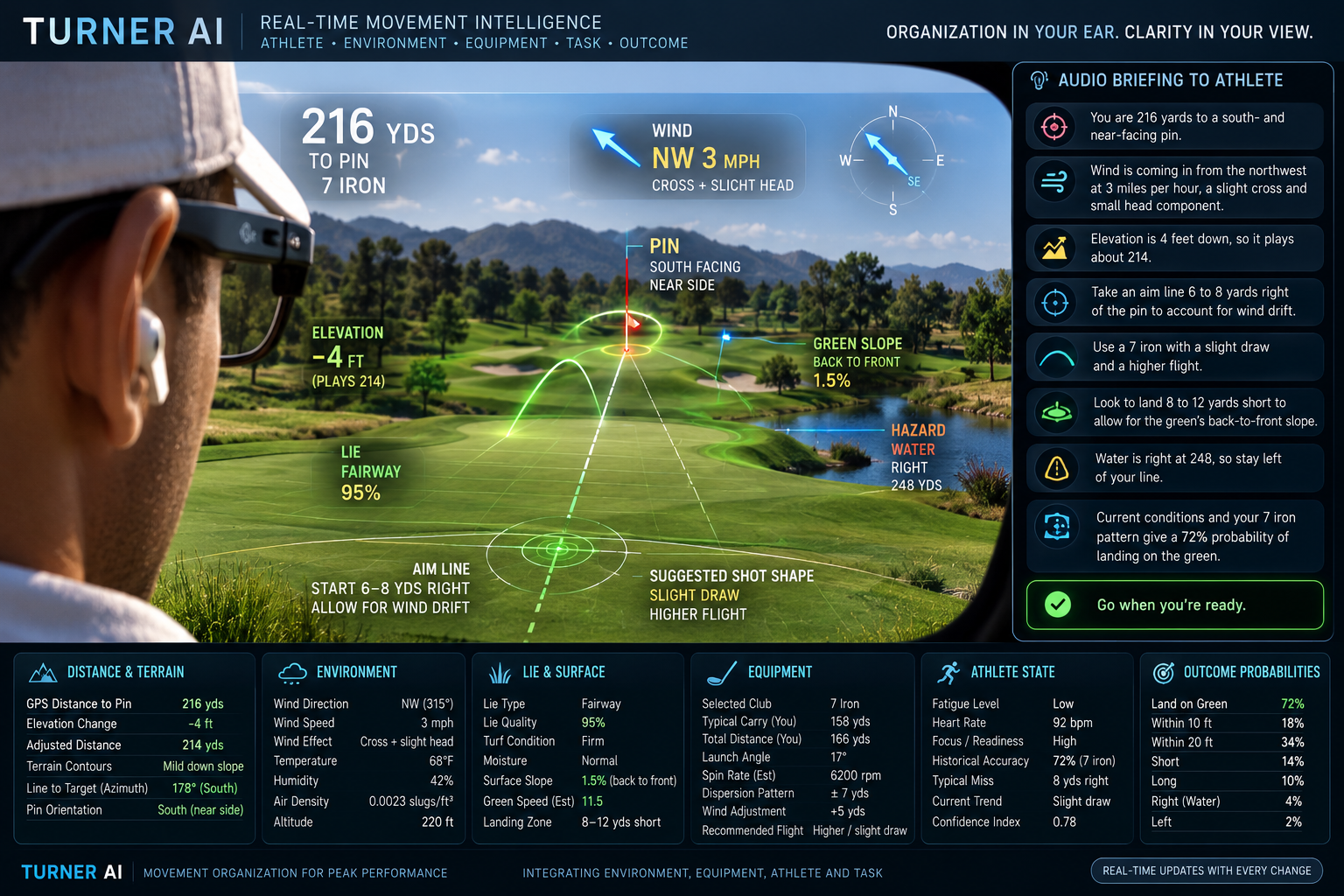
Applied to wearable intelligence, this creates a layer between sensing and action. Contemporary devices may already provide information about person or system state, environment, equipment, task demands, position, orientation, and context. Turner AI is designed to establish how those variables relate as a single changing physical situation. The objective is not to replace sensor fusion, computer vision, spatial computing, or domain-specific models, but to add an organizational layer capable of converting fragmented observations into relational state and Movement availability.
This architecture is intentionally hardware-independent. A wearable, robotic platform, industrial system, aerospace system, or performance technology may retain its existing sensors, interface, and domain science while accessing Turner as an organizational intelligence layer. Publicly, the architecture can be described at the level of evidence discipline, organizational hierarchy, state continuity, and change. The underlying mathematical representations, weighting systems, state-transition logic, thresholds, and implementation sequences remain proprietary.
The proposed contribution is therefore not another wearable application, but a distinct computational approach to physical-world intelligence: one that asks not only what is being observed, but how the observed system is organized, how that organization is changing, and what becomes available next.