You Gave Everyone the Same AI. You Didn't Give Them the Same Capability.
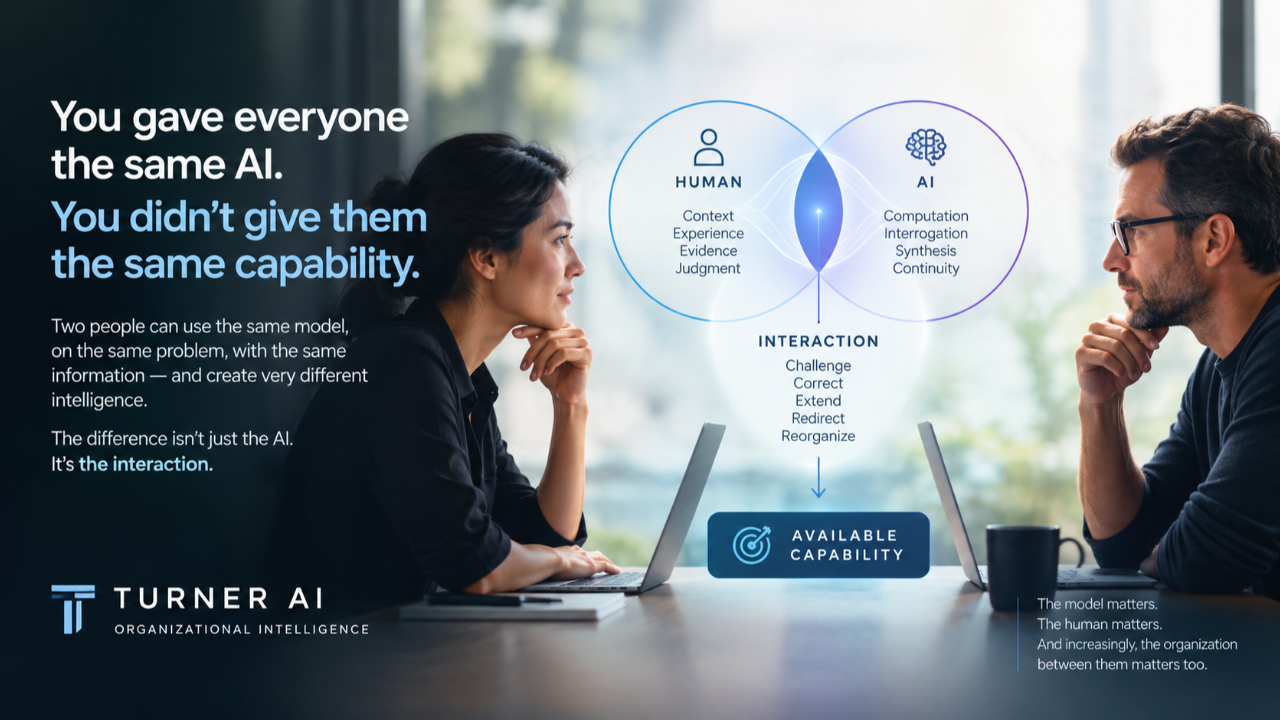
Companies are spending enormous amounts of money putting increasingly powerful artificial intelligence into the hands of their employees. The models are improving, enterprise access is expanding, and AI is being embedded into the software people already use. It is becoming reasonable for a company to say that hundreds or thousands of its employees now have access to essentially the same artificial intelligence.
But that does not mean those employees have access to the same capability.
This is becoming one of the more interesting problems we are examining at Turner AI because it changes where we look for AI capability. We are accustomed to looking inside the model. We benchmark reasoning, retrieval, coding, vision, context, speed and accuracy because those measures tell us something important about what the artificial system can potentially do. Once that system begins interacting with a human, however, the model is no longer operating alone.
Put exactly the same AI in front of two people and watch what happens.
One person asks a question, receives an impressive answer and moves forward with it. Another asks essentially the same question but notices that the answer rests on an assumption that has not been established. They challenge it. That changes the AI's reasoning. The AI identifies another relationship that the human had not considered. The human introduces additional evidence from their own experience. The original question changes. A contradiction appears. Instead of forcing the contradiction into the existing explanation, the human and AI reopen the problem. What eventually emerges may be considerably different from the answer produced at the beginning.
Nothing about the underlying model changed.
The interaction changed.
That distinction matters because we have spent a great deal of time talking about artificial intelligence as though capability lives entirely inside the technology. In practice, once AI enters complex human work, some of the capability becomes dependent upon the organization developing between the human and the artificial intelligence.
The human brings something to that relationship. They bring purpose, experience, context, evidence, judgment and responsibility. Artificial intelligence brings different capabilities: computation, interrogation, synthesis, information organization, continuity and the ability to examine enormous amounts of information in ways the human cannot reproduce independently.
The interesting part begins when those capabilities affect each other.
AI may identify a contradiction the human missed. The human may recognize that the AI has misunderstood the environment. AI may challenge an assumption the human has carried into the investigation. The human may possess contextual knowledge the AI could not possibly have inferred from the available information. New evidence can require both of them to change direction.
At that point, asking whether the human is “good at AI” is almost the wrong question. So is asking only how capable the model is.
The more useful question is: What capability becomes available through the interaction between them?
We Have Been Measuring the Ends of the System
Most organizations can tell you which AI systems they have deployed. Increasingly, they can tell you how frequently employees use them and which functions are producing measurable productivity gains. They may know how many people have activated an AI assistant, how many tasks have been automated and how much time employees report saving.
Those are legitimate measurements. They still leave a large part of the system invisible.
We know something about the human entering the interaction. We know a great deal about the AI. We can measure the output that comes out the other side. But what happened between the two is often treated as little more than prompting.
That is too small a representation of what is actually occurring.
Prompting describes one point in the interaction. Complex work can continue for minutes, hours, weeks or months. Problems evolve. Evidence accumulates. AI makes errors. Humans make errors. Context gets lost. Assumptions change. The AI introduces ideas. The human rejects some and develops others. Sometimes the system needs to preserve uncertainty rather than produce an answer. Sometimes the entire investigation needs to be reorganized because something discovered halfway through invalidates the structure that existed at the beginning.
The prompt is part of that environment. It is not the environment.
What we are beginning to examine through Turner AI's AI Interaction Profile work is the interaction itself as observable evidence. Instead of asking people only how they believe they use AI, we can begin comparing what they report with what actually becomes visible when they work with it. The distinction emerging in the work is simple but important: Self-Reported → Observed → Demonstrated.
Someone may tell us that they always verify AI answers. That tells us what they believe about their interaction, but it does not yet establish what happens when a convincing AI answer appears in front of them.
Now let the interaction unfold.
Suppose the AI generates a polished explanation that sounds entirely plausible but reaches beyond the evidence available. Does the human recognize that? Perhaps they do not. Later, contradictory evidence appears. Do they reopen the conclusion, or does the collaboration attempt to preserve what it already decided?
Now something has become observable that a questionnaire alone could never establish.
But the same principle has to work in the other direction. Suppose the AI identifies a genuine contradiction that the human missed. Does the person investigate it, or do they dismiss the AI because it has challenged their existing view?
That matters just as much.
A capable human–AI relationship cannot be defined simply by how well the human polices artificial intelligence. If we teach people that advanced AI use means constantly catching AI mistakes, we create another primitive relationship in which the human must always be right and the artificial intelligence must always be subordinate.
Sometimes the AI should change the human's thinking.
Sometimes the human should change the AI's reasoning.
Sometimes the available evidence should force both representations to change.
The important capability is whether the collaboration can determine which change is warranted.
A Good Output Can Hide a Poor Interaction
This creates another problem for organizations because generative AI is extraordinarily good at producing the appearance of capability.
A beautiful report can emerge from weak reasoning. A sophisticated analysis can contain an assumption nobody examined. A confident recommendation can conceal substantial uncertainty. Someone can produce work that looks dramatically more advanced than anything they could have produced independently, while having very little ability to determine whether the reasoning underneath it is defensible.
The AIP work describes one version of this as Operator Illusion: the apparent quality or sophistication of AI-assisted output can create an impression of human capability that has not actually been demonstrated.
That does not mean the person lacks capability. It means the output alone cannot establish it.
The opposite can happen as well. Someone who does not use sophisticated AI terminology and does not consider themselves an advanced user may demonstrate excellent organization once they begin working. They recognize when evidence is insufficient. They give AI contextual information it needs. They allow the system to challenge them when appropriate. They recognize when the AI has gone in the wrong direction and recover the interaction without throwing everything away.
If we measure only AI fluency, prompt sophistication or output quality, we may misread both people.
The AI Is Part of the Interaction Too
There is another reason this becomes important for auditing: when something goes wrong, we cannot automatically assign the failure to the human.
AI can lose a constraint that was established earlier. It can overgeneralize. It can introduce an unsupported inference. It can broaden an investigation until the original purpose disappears. It can compress previous reasoning and lose an important distinction. It can push toward an answer when the available evidence should have remained unresolved.
The interaction that follows is therefore being produced by more than one participant.
That is why our AIP work is moving toward preserving the human contribution, the AI contribution and the resulting collaborative outcome separately.
This may sound like a small analytical distinction, but it changes the audit substantially.
If an AI loses an important constraint and the human notices, restores it and continues the work, the interesting finding is not simply that an error occurred. We have observed something about recovery. If the AI identifies a contradiction that the human missed and the human uses that challenge to reorganize the investigation, we have observed something about the collaboration that would disappear if we looked only for AI mistakes.
The relationship itself is producing evidence.
This Creates an Invisible Capability Problem Inside Companies
Now imagine this happening across an organization.
A thousand employees may have access to exactly the same enterprise AI system. On an adoption dashboard they may appear relatively similar. They have licenses. They are active. They generate outputs. They save time.
Underneath those numbers, however, the organization's AI capability may be radically uneven.
One employee may primarily use AI as an answer generator. Another may have built a sophisticated collaborative environment in which months of context, evidence and organizational knowledge are being preserved. Another may be very good at detecting AI error but poor at allowing useful AI challenge. Another may create excellent results but depend completely upon one particular model, workflow or conversation history. Another may have developed a highly capable AI-supported process that nobody else in the organization understands well enough to continue.
That last example is especially important.
The company may believe it owns the capability because the work is being performed inside company systems. In reality, the capability may exist in the organization between one human and one artificial intelligence.
Remove the human and it disappears.
Change the AI and it disappears.
Lose the interaction history and it disappears.
Now what looked like AI capability has become an organizational continuity problem.
This is exactly why measuring AI adoption is not enough. The important question is not simply how many people are using artificial intelligence. It is what kind of capability is becoming organized through that use—and whether the organization itself can see it.
The Interaction Is Becoming Auditable
This is where I think AI auditing has to expand.
We absolutely need to audit models, data, security, compliance, outputs and technical performance. But as artificial intelligence moves deeper into professional work, the human–AI relationship becomes part of the operating system.
That relationship can be observed.
We can examine what happens when evidence changes. We can see whether direction drifts. We can observe whether the AI or the human recognizes a contradiction. We can distinguish a breakdown from the recovery that follows it. We can change the conditions and see whether the capability remains available. We can remove context and see what survives.
Most importantly, we do not have to convert those observations into personality judgments.
We can remain with the evidence.
That is the direction we are taking with Turner AI: not asking whether someone is inherently a good or bad AI user, but examining what organization becomes visible when human and artificial intelligence work together.
And that brings us back to the enterprise assumption we started with.
You can buy the same AI for everyone.
You can give everyone the same interface.
You can provide access to the same underlying model.
You can even teach everyone the same prompting techniques.
You still have not established that the same capability exists across the organization.
Because once the interaction begins, the artificial intelligence is no longer the only system that matters.
The human matters. The AI matters. And the organization that forms between them may determine what either becomes capable of doing next.
That is something worth learning how to see.
Turner AI | Organizational Intelligence
From observation to organization. For a more capable world.