Your AI Inventory Doesn't Clock Out When You Do
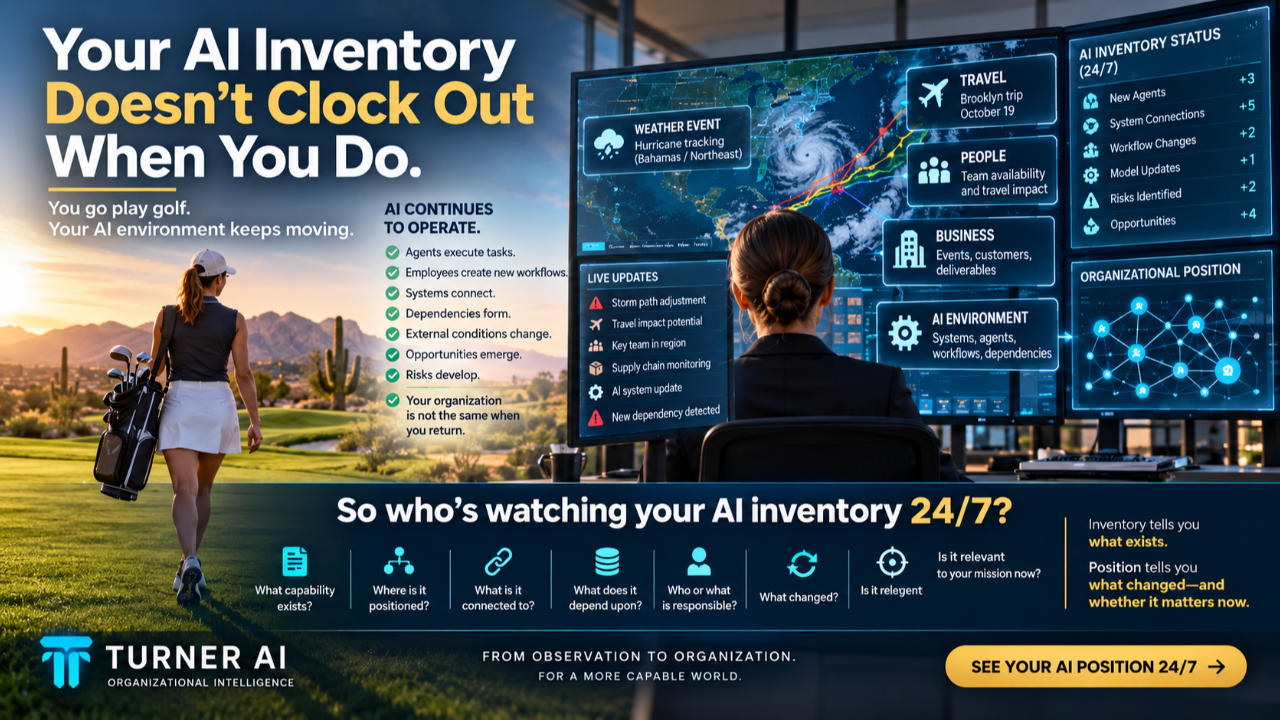
Your AI Inventory Doesn't Clock Out When You Do
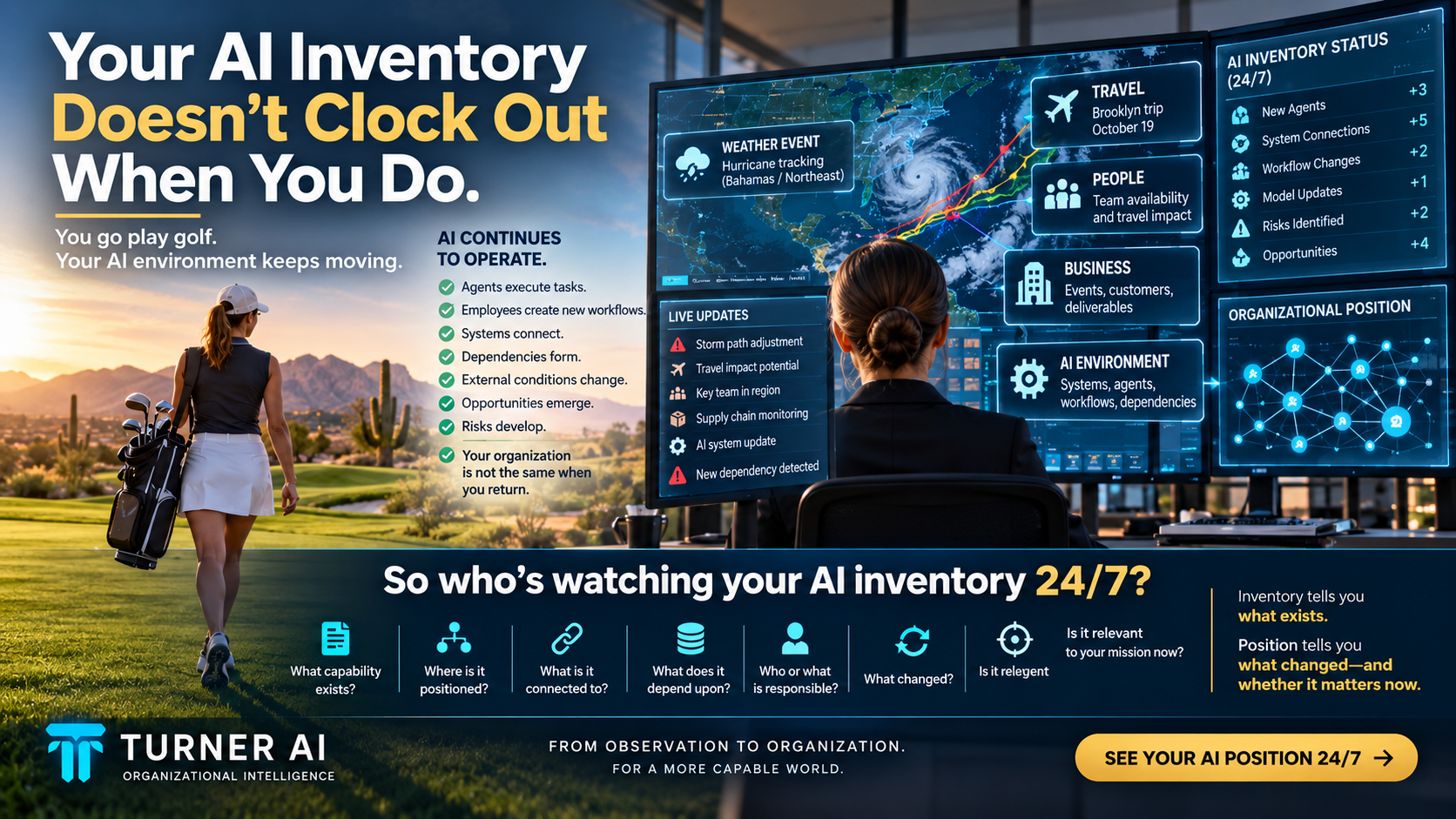
I'm going to play golf this morning.
My workday hasn't really started, but artificial capability doesn't care what time I tee off.
Across a modern organization, AI systems can continue operating while executives sleep, employees travel, teams sit in meetings and people take the weekend off. Agents can execute tasks. Employees can create new workflows. Applications can introduce new AI functionality. Models can change. Systems can become connected. Dependencies can form. Existing capabilities can become more important—or suddenly less available.
The organization you left yesterday may not be exactly the same artificial organization you return to tomorrow.
So who is watching your AI inventory 24 hours a day?
The question sounds like monitoring.
It is actually about organizational awareness.
An AI Inventory Is No Longer Just a List
Traditional technology inventory makes sense as a relatively straightforward question:
What software do we have?
What licenses did we purchase?
Who has access?
What systems are approved?
Those questions still matter.
But artificial capability introduces something more dynamic.
Imagine an employee creates an agent that performs part of a business function. Another employee connects AI to an existing workflow. A third discovers a substantially better way of performing research. Two departments independently develop similar capabilities. An important workflow gradually becomes dependent upon a particular model. A SaaS product introduces an AI feature that changes what employees can accomplish with software the organization already owns.
The individual technologies may remain exactly where they were on yesterday's inventory.
The organization's AI position has still changed.
That is why inventory alone is becoming insufficient.
An organization increasingly needs to understand not only what artificial technology exists, but where capability exists, what it is connected to, what it depends upon, who or what is responsible for it, and how those relationships are changing.
The Important Change May Not Happen Inside the AI
There is another problem.
Something outside the organization's artificial systems can change the significance of something inside them.
This is where multi-domain intelligence becomes important.
Multi-domain does not simply mean an AI system is capable of discussing finance, weather, physics, logistics, software and marketing.
That is breadth of knowledge.
Organizational intelligence requires something more difficult:
the ability to preserve and reorganize relationships across domains as conditions change.
A weather event may initially have nothing to do with an organization's AI inventory.
Then conditions change.
A key employee is traveling through the affected region. A distribution center sits in the projected path. A customer operation may be disrupted. Transportation changes. Inventory cannot arrive. A scheduled event becomes uncertain. An employee who maintains an important AI-supported workflow becomes unavailable.
The weather did not become an AI application.
The organizational relationship changed.
Suddenly something that appeared to belong to an entirely different domain can affect the availability of artificial capability somewhere else in the organization.
That is why simply separating information into domains can create its own kind of blindness.
Relevance Changes
This creates a difficult problem for AI.
Not everything should be treated as relevant all the time.
A company does not need an artificial system constantly reporting every weather event, employee movement, software update, customer change and operational condition simply because one of those things might someday matter.
That would not be intelligence.
It would be noise.
The harder problem is recognizing when a relationship that previously did not matter becomes organizationally relevant.
Something can exist today without affecting the mission.
Tomorrow another condition changes.
Now it matters.
The information itself may not have changed.
Its position relative to the organization has.
This means relevance cannot always be permanently assigned to information when that information first enters a system.
Relevance can emerge from changing relationships, conditions and mission.
What Does 24/7 Actually Mean?
This changes what continuous AI awareness should mean.
It should not mean someone staring at a dashboard twenty-four hours a day.
It should not mean indiscriminate surveillance.
And it should not mean generating an endless stream of alerts every time something changes.
The objective is organizational continuity.
The system should be capable of recognizing meaningful changes in organizational position.
What artificial capability exists?
Where is it?
What is it connected to?
What depends upon it?
What does it depend upon?
What changed?
Did that change alter capability, responsibility, continuity or mission?
And did something that previously appeared unrelated just become relevant because another relationship changed?
That is a very different problem from maintaining an AI asset list.
From Inventory to Position
This is why Turner AI Global Positioning is not simply an AI inventory concept.
Inventory asks:
What do we have?
Position asks:
Where are we now?
And organizational position requires relationships.
A company may have exactly the same applications at 5:00 PM that it had at 8:00 AM while its actual AI position has changed substantially.
A new capability emerged.
A dependency formed.
A workflow changed.
An agent became operationally important.
A human became unavailable.
An external condition altered what the organization can accomplish.
Two previously unrelated parts of the organization suddenly became connected by circumstance.
The inventory may look identical.
The organization isn't.
Your AI Environment Doesn't Wait for You
Executives should be able to play golf.
Employees should be able to sleep.
People should take vacations.
Nobody should have to continuously watch every artificial system, workflow, employee interaction and external condition just to understand whether the organization has changed.
That is exactly why organizational intelligence matters.
The objective isn't to watch everything.
It is to preserve enough organizational continuity to recognize when something that matters has changed.
And that may ultimately be one of the most important differences between an AI inventory and an intelligent organizational system.
Inventory tells you what exists.
Position tells you how what exists is currently organized.
Organizational intelligence recognizes when that position changes—and when previously separate information becomes relevant because of it.
Your AI inventory doesn't clock out when you do.
The question is whether your organization will know what changed while you were gone.
Turner AI | Organizational Intelligence
From observation to organization. For a more capable world.