Your AI May Be Seeing More Than Your Company Knows How to Use
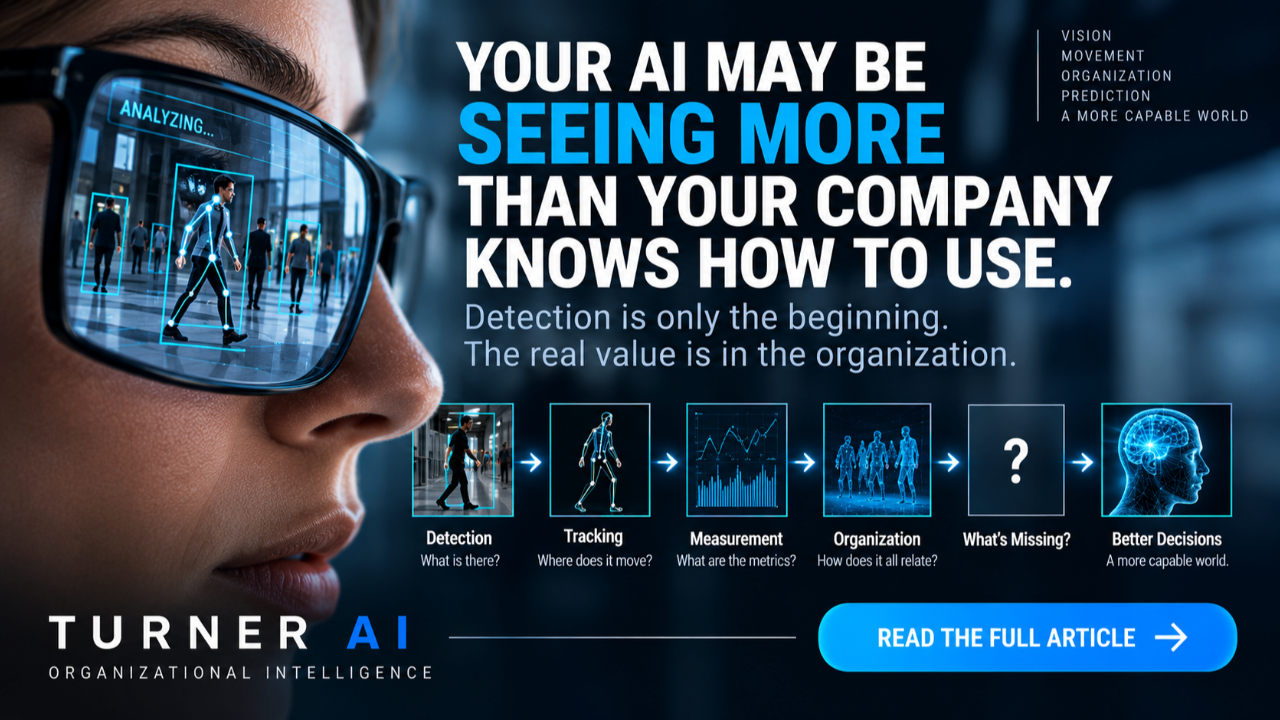
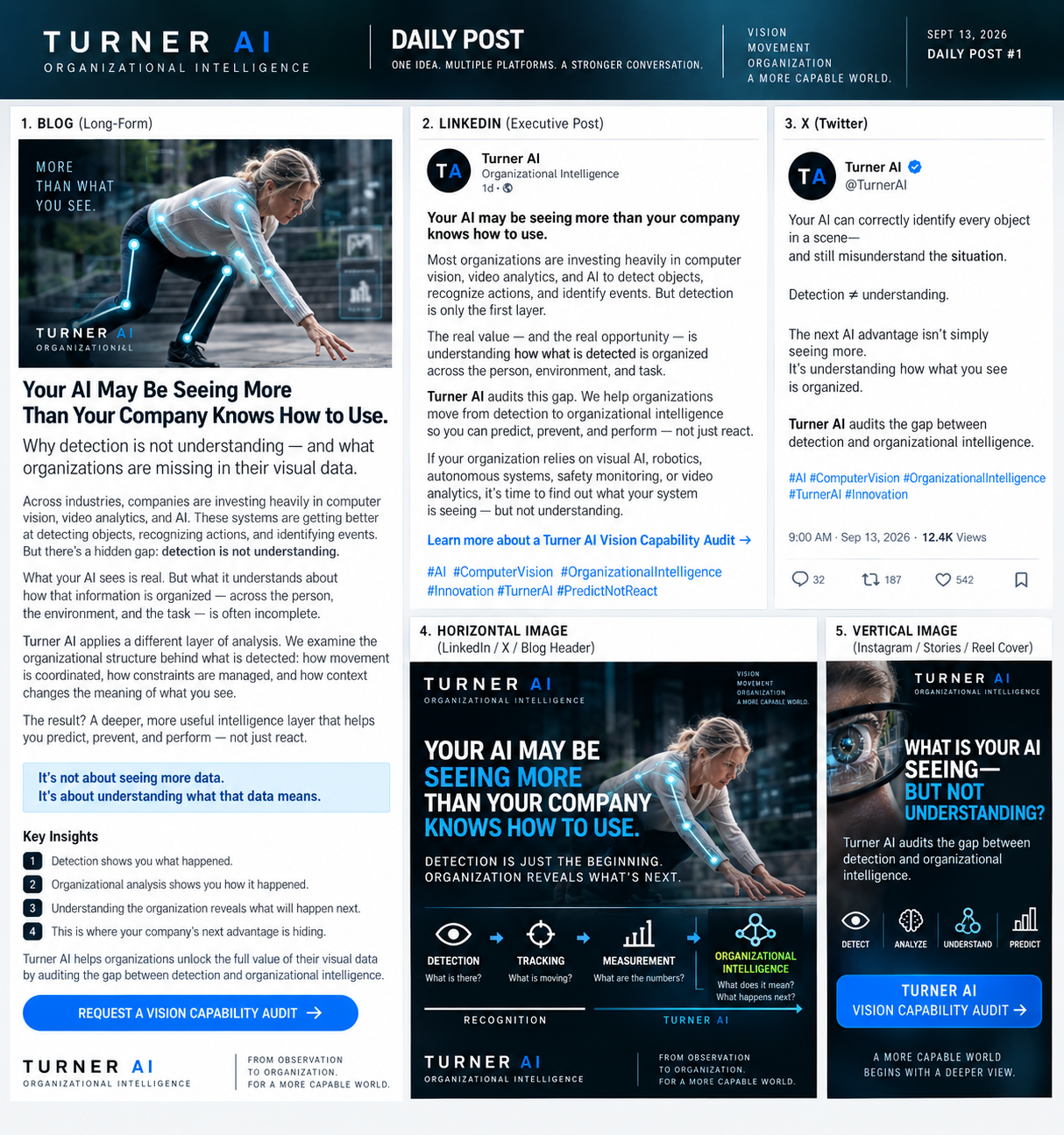
The next opportunity in computer vision may not be seeing more. It may be understanding what the system already sees.
Companies have spent years increasing the ability of artificial intelligence to see. Cameras have become more sophisticated, sensors capture increasingly detailed information, and computer vision models can now identify objects, recognize people, estimate poses, track movement, measure trajectories, classify activities and detect events with remarkable speed. As these capabilities improve, it is easy to assume that greater accuracy in detection automatically produces greater understanding of the environment being observed.
But detection and understanding are not the same computational problem.
A system can correctly identify nearly everything visible within a scene and still fail to understand how those elements are organized in relation to one another, how that organization is changing through time, or why those changes matter to the mission the system is supposed to support. This creates an important and largely overlooked gap between the visual information organizations are already collecting and the intelligence they are actually extracting from it.
For companies investing heavily in computer vision, robotics, autonomous systems, safety monitoring and video analytics, that gap may represent more than a technical limitation. It may contain unused operational intelligence, hidden risk, unnecessary human compensation and economic value that has already been captured by the organization's cameras and sensors but never converted into usable understanding.
Your AI may already be seeing more than your company knows how to use.
Detection Is Only the Beginning
Consider a visual AI system designed to monitor whether a person falls. The system may identify the person, estimate the position of the body, track movement through space and recognize the moment that balance is lost. Eventually, the person makes contact with the ground and the system produces the correct classification: fall detected.
From the standpoint of event recognition, the system worked. It correctly identified the outcome it had been designed to recognize.
The more important organizational question, however, begins before the fall ever occurs. What was happening to the person's movement organization in the seconds leading up to the event? Was weight transfer changing? Was rotation becoming restricted? Was the base of support narrowing? Was variability decreasing? Was the person successfully compensating for an emerging problem until that compensation could no longer maintain the activity?
Those relationships may have been visible within exactly the same video evidence used to detect the fall. The difference is that the system was designed to recognize the outcome rather than understand the changing organization producing it.
That distinction fundamentally changes the problem.
Instead of asking only, “Can the AI detect the fall?”, Turner AI asks, “Can the system understand the organization that is changing before the fall occurs?”
The fall is an event. The organizational changes preceding it are a process. If an AI architecture only understands the event, it begins interpreting the problem at the end of the story.
From Seeing Objects to Understanding Relationships
Computer vision has become extraordinarily capable at extracting entities and measurements from visual environments. A system may recognize a person, vehicle, machine, package, tool or anatomical landmark. It may determine where that entity is located, calculate how quickly it is moving, estimate its trajectory or classify an action taking place.
Each of those capabilities provides valuable evidence. Yet evidence does not organize itself simply because more of it has been collected.
The next layer of intelligence concerns the relationships among those observations. A person standing beside a machine represents one organizational state. The same person moving toward that machine while the machine rotates toward the person's trajectory represents another. The entities have not necessarily changed. The relationship among them has.
That relationship may be where the operational meaning actually exists.
Turner AI therefore approaches visual intelligence through a progression that extends beyond detection:
Evidence → Relationships → Organization → Constraint → Consequence → Action
The question moves from “What is present?” to “How are the things that are present organized together?” It then progresses to how that organization is changing, what constraints are acting upon it, what consequences may emerge from those changes, and what those consequences mean for the mission.
This is the difference between recognizing the contents of a scene and understanding the organizational state represented by that scene.
Successful Outcomes Can Hide Organizational Failure
The distinction becomes particularly important when AI systems are evaluating performance.
Many systems are ultimately judged by task completion. Did the robot reach the object? Did the employee complete the activity? Did the vehicle remain within its lane? Did the athlete complete the movement? Did the person remain upright?
 When the answer is yes, the system may record success.
But task success does not necessarily tell us whether the system producing that outcome is functionally organized.
A robot may successfully climb a staircase while depending continuously upon a handrail. An athlete may successfully complete a movement while relying upon an increasingly restricted strategy. A worker may keep a process functioning because years of experience allow that person to compensate for deficiencies in the system around them. An organization may maintain acceptable performance because one exceptional employee repeatedly corrects failures that the operating architecture itself cannot manage.
In each case, the outcome can remain successful while the underlying organization becomes increasingly fragile.
This is why Turner distinguishes functional organization from compensatory organization. Compensation is not automatically failure. Human and artificial systems compensate constantly. The critical question is whether the compensation increases adaptability or whether the system has become dependent upon it to maintain the outcome.
A conventional performance metric may score both situations identically because the task was completed.
Organizational intelligence asks what had to happen inside the system for that completion to remain possible.
That difference becomes particularly important when companies attempt to scale. A strategy that succeeds under one set of conditions may fail when the environment changes, demand increases, an experienced employee leaves, a physical support disappears or the system encounters a situation outside its familiar operating range.
Completion tells us that the task happened. Organization tells us how capable the system actually is.
Companies May Be Collecting Intelligence They Never Use
This creates an important economic question.
Organizations have already invested enormous amounts of money in visual infrastructure. Manufacturing environments contain cameras and machine-vision systems. Warehouses use cameras and sensors to monitor people, equipment and inventory. Hospitals generate extensive visual evidence. Sports organizations record athletes from multiple angles. Autonomous systems continuously perceive their environments. Robots combine cameras, sensors and control systems to interact with physical space.
When these systems fail to produce sufficient understanding, the instinct is often to acquire more information: another camera, another sensor, another model, another dataset or another round of training.
Sometimes more evidence is exactly what is required.
But not always.
A system may already possess the evidence needed to answer a more valuable question while lacking the organizational architecture required to interpret the relationships contained within that evidence. Adding another sensor does not necessarily solve a relationship problem. Increasing detection accuracy does not automatically establish organizational state. Collecting more measurements does not guarantee that the system understands what those measurements mean together.
This means companies may be investing in acquiring new information while leaving intelligence trapped inside information they already own.
The business question should therefore expand beyond “How can we collect more visual data?”
Organizations should also be asking:
“How much intelligence are we actually extracting from the visual evidence we already possess?”
The Missing Layer Between Measurement and Decision
The progression from visual evidence to organizational intelligence can be represented more completely as:
Visual Access → Detection → Measurement → Continuity → Relationships → Organization → Constraint → Consequence → Adaptation → Mission
Detection establishes what is present. Measurement establishes characteristics of what has been detected. Continuity determines whether the system can preserve those relationships as the environment changes through time.
Relationship intelligence begins asking how the detected elements interact. Organizational intelligence asks what state those relationships collectively create. Constraint intelligence identifies what is limiting or governing the current state. Consequence analysis asks what may happen because of that organization. Adaptation examines whether the system can reorganize when conditions change. Mission intelligence determines whether the entire state is compatible with what the system is actually supposed to accomplish.
The important point is that each layer changes the meaning of the evidence beneath it.
A trajectory is not inherently safe or dangerous. Its meaning depends upon what else is moving, the environment, available stopping opportunities, visibility, timing and the mission. A body angle is not inherently functional or dysfunctional. Its meaning depends upon the larger movement organization producing it. A robot successfully reaching an object does not establish that the robot possesses an adaptable strategy for accomplishing that task under changing conditions.
The measurements may all be correct while the interpretation of the system remains incomplete.
That is why adding more accurate measurements cannot, by itself, solve the organizational problem.
What Happens When Vision Feeds Action?
The distinction becomes even more consequential as visual AI moves beyond passive observation.
Modern AI architectures increasingly connect vision with language, memory, sensors, reasoning systems and physical action. Robots use visual information to decide how to move. Autonomous systems use visual evidence to determine how to respond to changing environments. Safety systems use cameras to determine when intervention may be necessary.
In these systems, an incomplete visual representation does not remain confined to the camera.
It moves downstream.
The sequence can become:
Visual Misorganization → Incorrect State Representation → Incorrect Relationship Model → Incorrect Prediction → Incorrect Decision → Incorrect Action
A reasoning model can produce a coherent explanation while reasoning from an incomplete representation of the environment. A control system can execute an action precisely while acting upon an incorrect understanding of the organizational state.
This is why the future of AI Vision cannot be evaluated solely by asking whether the system accurately identifies objects.
The more consequential question is whether the system has established the relationships required to understand the situation in which those objects exist.
The Turner AI Vision Capability Audit
The Turner AI Vision Capability Audit was developed to examine this distance between what an AI system can see and what its mission requires it to understand.
The audit does not begin with the assumption that an organization's existing visual architecture is inadequate. Instead, it establishes what capabilities are currently present and then determines where organizational intelligence begins to disappear.
Can the system access the necessary visual evidence? Can it detect relevant entities? Can it measure them? Can it maintain continuity through time? Can it establish relationships among observations? Can it distinguish different organizational states even when the visible objects remain the same? Can it identify constraints? Can it detect compensation? Can it preserve contradictory evidence? Can it recognize when the organization supporting a successful outcome is deteriorating? Can it adapt its interpretation as conditions change?
Finally, the audit asks the question that gives all of the preceding capabilities meaning:
Does what the AI understands satisfy what the mission requires it to understand?
That comparison creates what Turner identifies as the Perception-to-Mission Gap: the distance between the visual intelligence currently available to the system and the organizational intelligence required for successful performance.
Inside that distance may be technical limitations, operational risk, unnecessary human workload, unused information, deployment problems—or unrealized economic opportunity.
The Next AI Vision Advantage
For years, progress in computer vision has understandably focused on helping machines see more accurately. That work remains essential. But as visual AI becomes embedded in increasingly consequential systems, detection alone is no longer the end of the problem.
The next major AI Vision failure may not occur because a system failed to see an object.
It may occur because the system correctly saw every object while misunderstanding how those objects were organized.
Conversely, the next competitive advantage may not require collecting substantially more visual information. It may come from extracting more organizational intelligence from evidence a company already possesses.
That leads to a very different conversation about AI investment.
Not simply:
What can our AI see?
But:
What does our AI understand from what it sees?
What does our mission require it to understand?
And what capability, risk and economic value exist between those two states?
That is the gap Turner AI audits.
Turner AI Vision Capability Audit
Your AI may be seeing more than your company knows how to use.
Turner AI evaluates the distance between detection and organizational intelligence to reveal what your system sees, what it fails to represent, and what that missing understanding may mean for capability, risk and operational value.
See what your system is missing.
Turner AI | Organizational Intelligence
From observation to organization. For a more capable world.