Your AI Worked. But Do You Know Why?
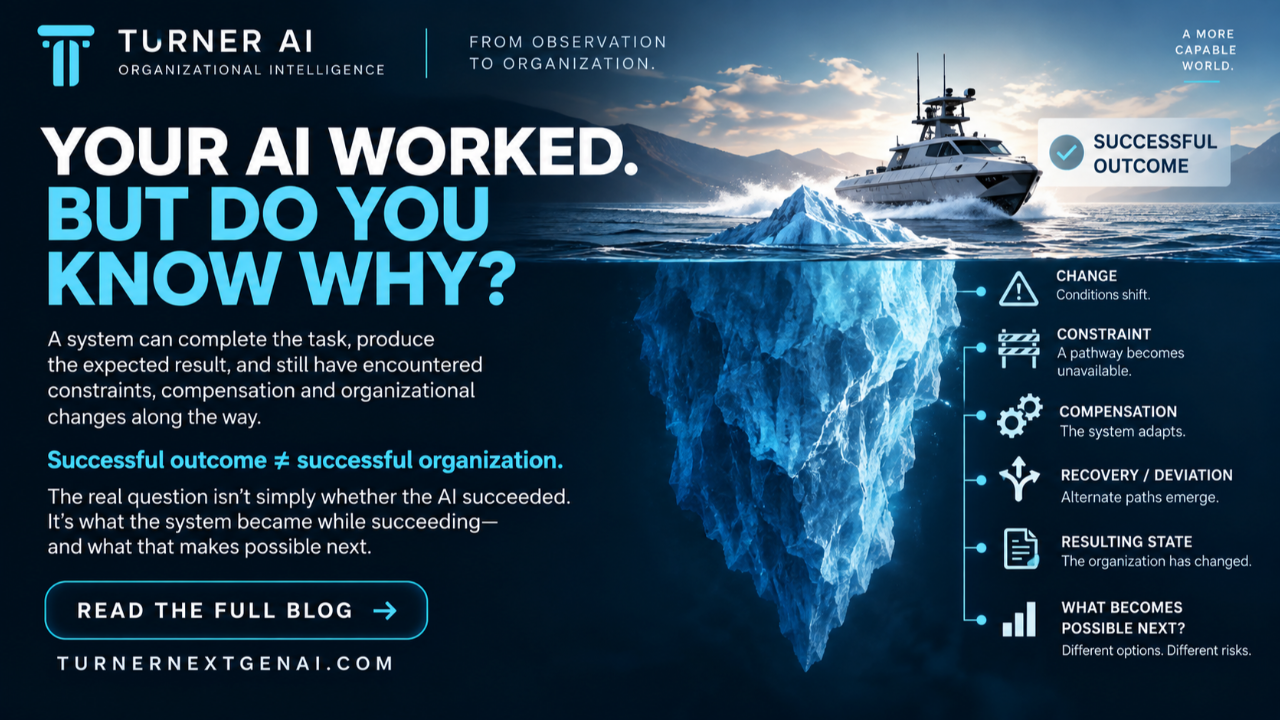
The next challenge in artificial intelligence isn’t simply getting systems to perform. It’s understanding the organization that makes performance possible.
For much of the development of artificial intelligence, success has been relatively easy to define. We gave a system a task and asked whether it could accomplish it. Could the vision model identify the object? Could the robot navigate the room? Could the agent complete the workflow? Could the autonomous system reach its destination?
Those were important questions because, for a long time, simply getting the technology to work was the challenge.
That is changing.
AI systems are becoming capable enough that successful task completion can no longer tell us everything we need to know about the intelligence operating underneath it. A system can produce the expected result while the organization supporting that result is changing, compensating, becoming constrained, or even deteriorating.
In other words, an AI can work without us fully understanding how it is working.
That creates an entirely different problem for AI auditing.
Success Can Hide a Lot
Consider two autonomous systems given the same task. Both complete it successfully.
The first moves through the task with the expected resources, relationships and transitions available throughout the process. When conditions change, the system adapts without disrupting the organization required to continue.
The second system also completes the task, but something very different happens along the way. A constraint develops. One expected pathway becomes unavailable. Another part of the system compensates. That compensation preserves the immediate task but places additional demand somewhere else. The system reaches the same final result, yet the organization that produced it has changed.
If we evaluate only the outcome, the distinction disappears. Both systems succeeded.
If we evaluate the organization, however, we have two very different pieces of information about what may happen next.
This is a distinction we have worked with for years in Movement science at Turner. Achievement does not necessarily establish organizational integrity. A person can accomplish a movement through very different organizations, just as an artificial system can accomplish a task through very different organizations.
The completed task is evidence. It is not the whole story.
We Have Become Very Good at Seeing
Modern AI can observe extraordinary amounts of information. Computer vision can detect and track people, vehicles, equipment, objects and environmental features. Sensors can continuously report temperature, acceleration, orientation, pressure, location and thousands of other variables. Autonomous systems can produce enormous logs documenting what occurred throughout an operation.
The natural response has been to keep improving the observation.
Add another sensor. Increase the frame rate. Improve the detector. Collect more telemetry. Preserve more logs. Increase the resolution.
All of those advances can provide valuable evidence, but there is a fundamental distinction between seeing a system and understanding a system.
Suppose a camera detects every person and machine on a factory floor with remarkable accuracy. We now know what is there. Tracking allows us to know where those things move. Additional sensors may tell us how quickly they move, how close they are to one another, and when particular events occur.
None of that automatically tells us how the factory is organized.
To understand the operation, we have to move into relationships. Which people are performing which functions? What processes depend on other processes? Where are resources becoming constrained? Why is movement accumulating in one part of the facility? Is a worker moving repeatedly because that is the intended workflow, or because that worker is compensating for a problem somewhere else?
The observations may be completely accurate while the understanding remains incomplete.
That is why one of the principles behind Turner AI is deceptively simple:
Observation is evidence, not understanding.
More Data Does Not Automatically Become More Intelligence
This distinction becomes even more important as systems become more complex.
A single observation can often be interpreted fairly easily. But real environments rarely contain a single variable. People move. Machines change state. environmental conditions change. Resources become available and unavailable. Decisions alter what happens next. One change propagates into another part of the system.
At that point, intelligence is no longer simply a detection problem. It becomes an organizational problem.
The important question is not only, What changed?
It is also, What did that change alter?
A seemingly small deviation may disappear without consequence. Another may force compensation elsewhere. That compensation may successfully preserve the immediate objective, but it may also change the conditions available for the next objective.
This is where conventional performance measures can become deceptive. If the system continues producing successful outputs, the compensation may look like successful performance.
Until it isn't.
The final failure may be the first thing we measure even though it was the last thing that happened.
What Happened Before the Failure?
Think about a fall.
A conventional detection system may become extremely good at recognizing when a person has fallen. It can identify the person upright, detect the transition, classify the fall, and issue an alert.
That capability has value.
But if the mission is to prevent the fall, recognizing the outcome is already too late.
Before someone reaches the floor, their organization may already have been changing. Support may have shifted. Left-right relationships may have changed. Compensation may have appeared. Recovery options may have become progressively unavailable.
The fall is not necessarily the beginning of the event.
It may be the final observable consequence of an organizational change that began earlier.
The same principle can be applied far beyond human Movement. A robot can complete a maneuver while compensating for a developing constraint. An AI agent can finish a workflow while requiring increasing human correction. A manufacturing system can maintain production while workers compensate for an inefficient process. An autonomous system can accomplish an objective while progressively reducing the options available for what it can safely do next.
If we only audit the final outcome, all of those systems can appear successful.
Organizationally, they may be telling us something very different.
Auditing the Organization Changes the Question
This is why I think we need to expand what we mean by an AI audit.
Auditing an intelligent system cannot eventually be limited to counting errors, measuring accuracy, checking compliance, or determining whether the expected output occurred. Those are important pieces of evidence, but they are still observations of the system.
An organizational audit asks something deeper: What organization produced this result?
Once we ask that question, we can begin investigating how relationships changed during execution. We can examine where constraints emerged, whether another part of the system compensated, whether that compensation changed downstream conditions, whether the system recovered, and whether the organization remaining at the end of the task is equivalent to the organization that existed at the beginning.
That last distinction is particularly important.
A system doesn't simply produce an outcome and disappear. Its resulting state becomes the starting condition for whatever happens next.
The real question therefore isn't merely whether the system succeeded.
It is whether we understand what the system became while succeeding.
AI Also Needs to Know What It Does Not Know
There is another layer to this problem that becomes increasingly important as AI systems are trusted with more consequential decisions.
Artificial intelligence is extraordinarily capable of producing interpretations from incomplete information. In many applications, that is precisely what makes AI useful. But inference becomes dangerous when the distinction between evidence and interpretation disappears.
A sensor reading may establish one condition while leaving another unknown. A camera may establish that an object was detected without establishing everything about the environment surrounding it. A model may assign a high confidence score while a critical variable was never represented in the first place.
The audit therefore has to preserve more than the answer. It has to preserve the epistemic structure behind the answer.
What was actually observed? What was inferred? What assumptions were required? What information was missing? At what point did evidence become interpretation? And does the available evidence actually authorize the conclusion being made?
That isn't a weakness in intelligence.
Knowing what remains unknown is part of intelligence.
From Failure Detection to Organizational Understanding
We are reaching a point where asking whether AI “works” is becoming insufficient.
The more autonomous these systems become, the more important it will be to understand the organization supporting their performance. We will need systems capable of distinguishing successful execution from successful organization, recognizing compensation before it becomes failure, preserving the relationships between evidence and inference, and understanding how the current state changes what becomes possible next.
That requires moving beyond an intelligence architecture centered only on detection and output.
At Turner AI, we are working on that missing organizational layer.
The objective isn't simply to build AI that sees more. It is to build systems capable of organizing what they observe into meaningful relationships, maintaining those relationships through change, identifying deviation and recovery, and producing intelligence that humans can actually use.
Because ultimately, the most interesting question may not be:
Did the AI succeed?
It may be:
What organization made that success possible—and what does that organization make possible next?
That is a very different way of looking at artificial intelligence.
And it is where the audit begins.