Hurricane Polo — From AI Source Organization to Observed Hydrologic Reorganization
Turner AI Experimental Report
Hurricane Polo Case 001 — From Source Organization to Observed Hydrologic Reorganization
Date: September 28, 2026
Project: Turner AI / Turner OS
Experimental inquiry: Can Turner observe and discuss organizational change in a complex physical system while maintaining evidentiary boundaries over time?
Executive Summary
 The Hurricane Polo experiment has now reached an important milestone.
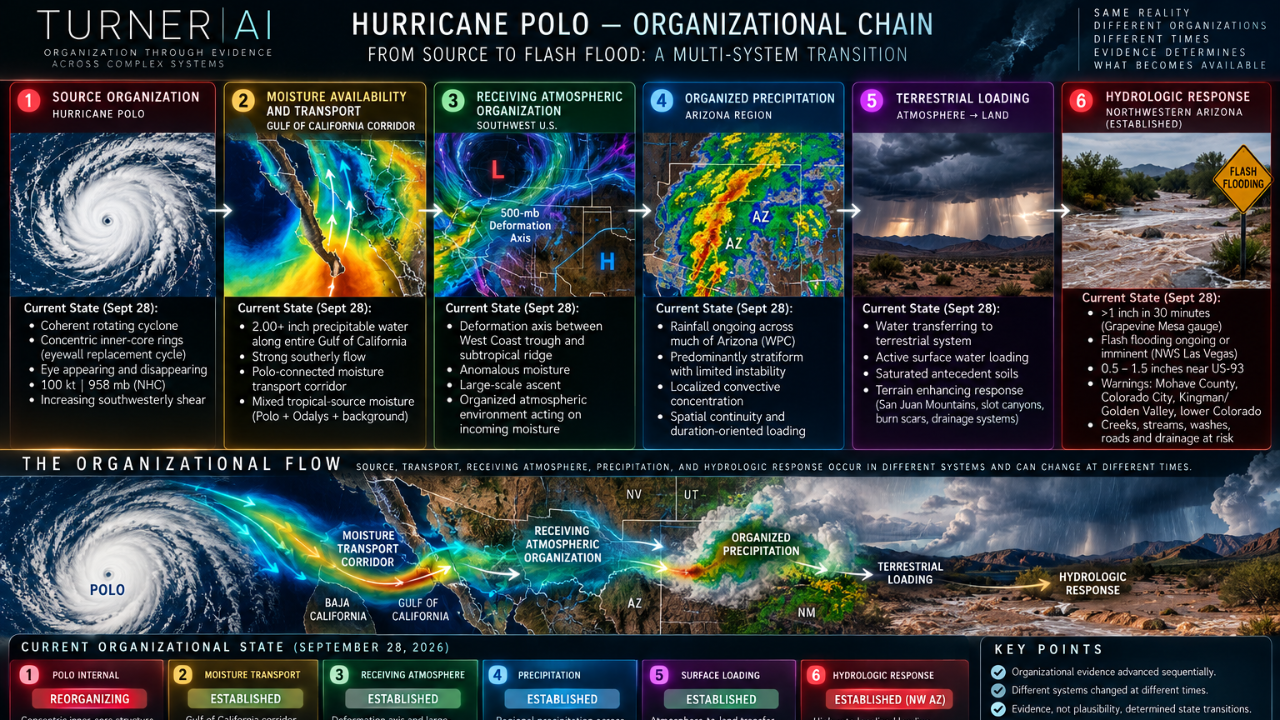
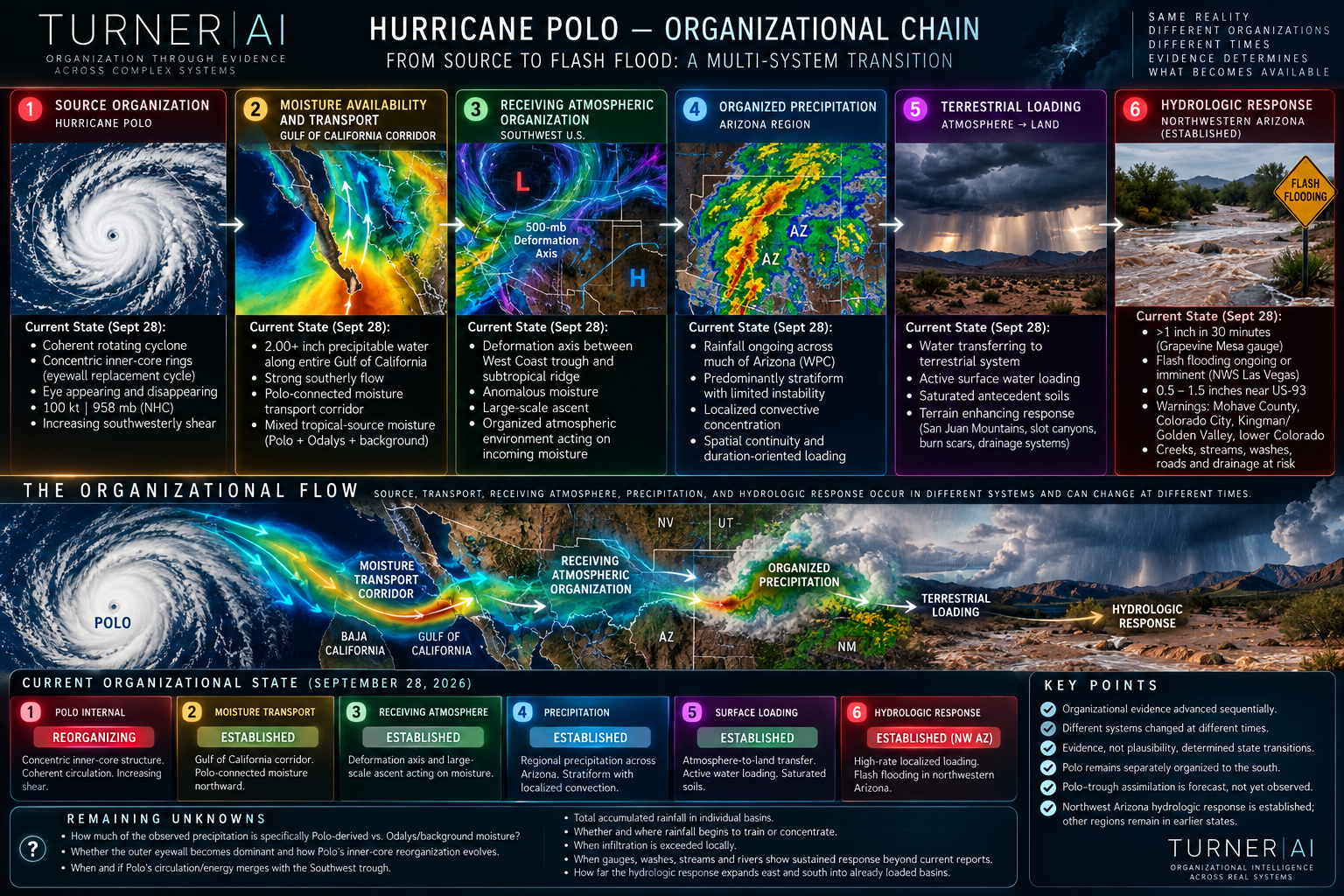
For the first time in the case, Turner has followed an observationally supported organizational sequence from a tropical cyclone through an environmental transfer pathway, into a separately organized receiving atmosphere, through precipitation and surface loading, and finally into an observed localized hydrologic/flash-flood state in northwestern Arizona.
The sequence currently represented by the experiment is:
Polo internal organization
→ tropical moisture availability and transport
→ Southwest receiving-atmosphere organization
→ organized precipitation
→ terrestrial ...
Your AI Inventory Doesn't Clock Out When You Do
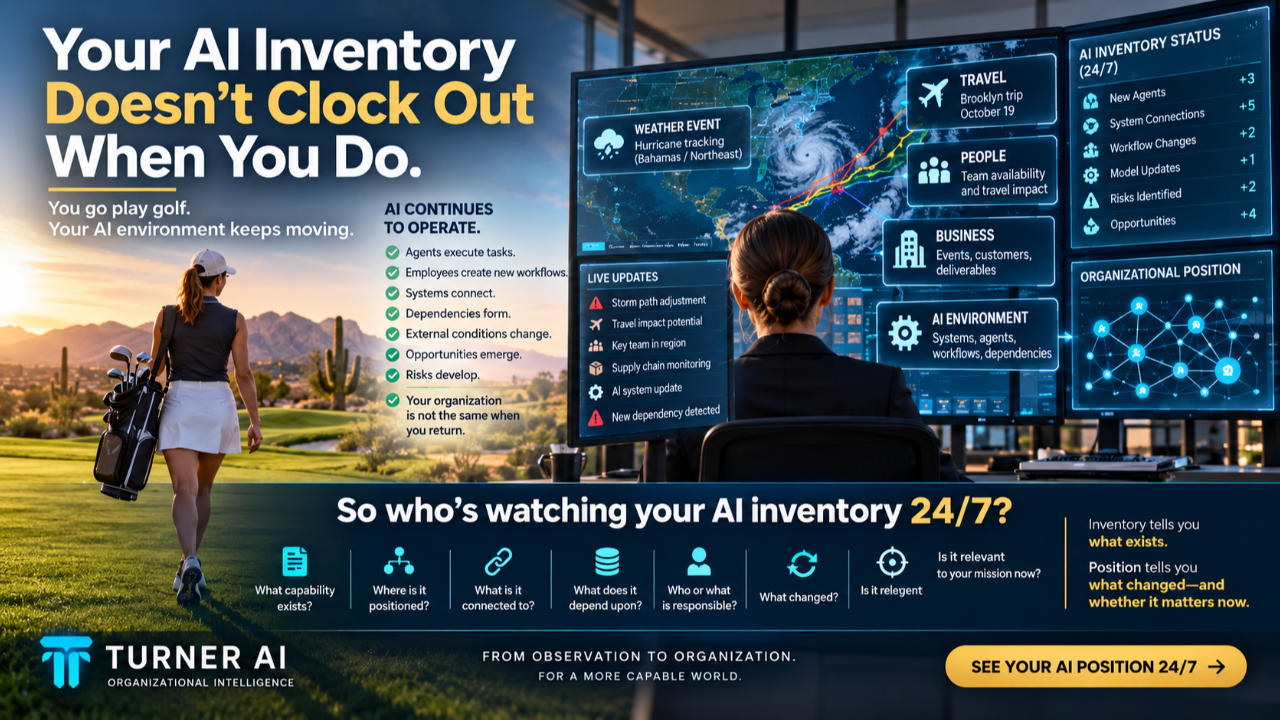
Your AI Inventory Doesn't Clock Out When You Do
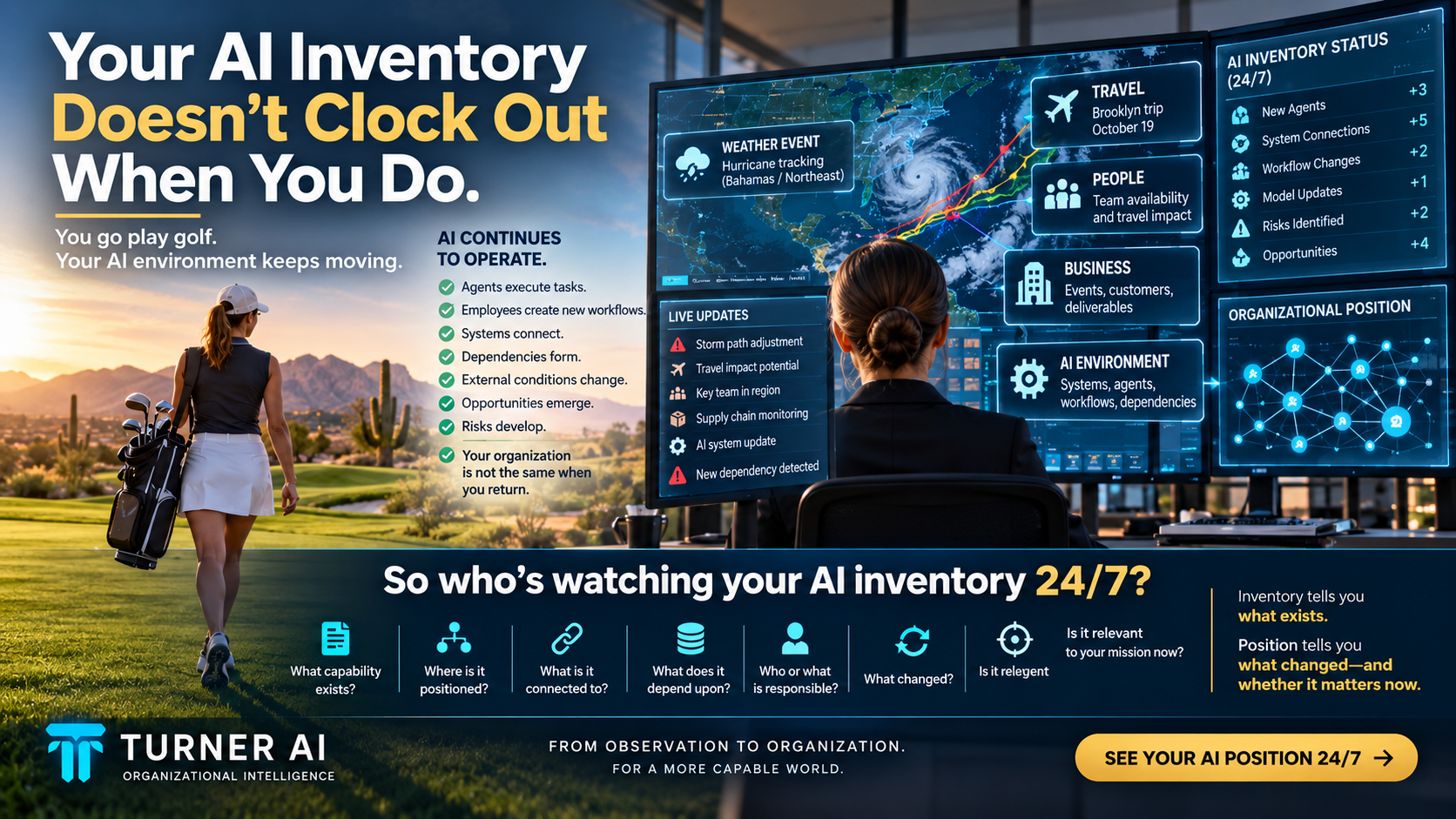
I'm going to play golf this morning.
My workday hasn't really started, but artificial capability doesn't care what time I tee off.
Across a modern organization, AI systems can continue operating while executives sleep, employees travel, teams sit in meetings and people take the weekend off. Agents can execute tasks. Employees can create new workflows. Applications can introduce new AI functionality. Models can change. Systems can become connected. Dependencies can form. Existing capabilities can become more important—or suddenly less available.
The organization you left yesterday may not be exactly the same artificial organization you return to tomorrow.
So who is watching your AI inventory 24 hours a day?
The question sounds like monitoring.
It is actually about organizational awareness.
An AI Inventory Is No Longer Just a List
Traditional technology inventory makes sense as a relatively straightforward question:
What softw...
Hurricane Polo and Its Turner AI Tracker
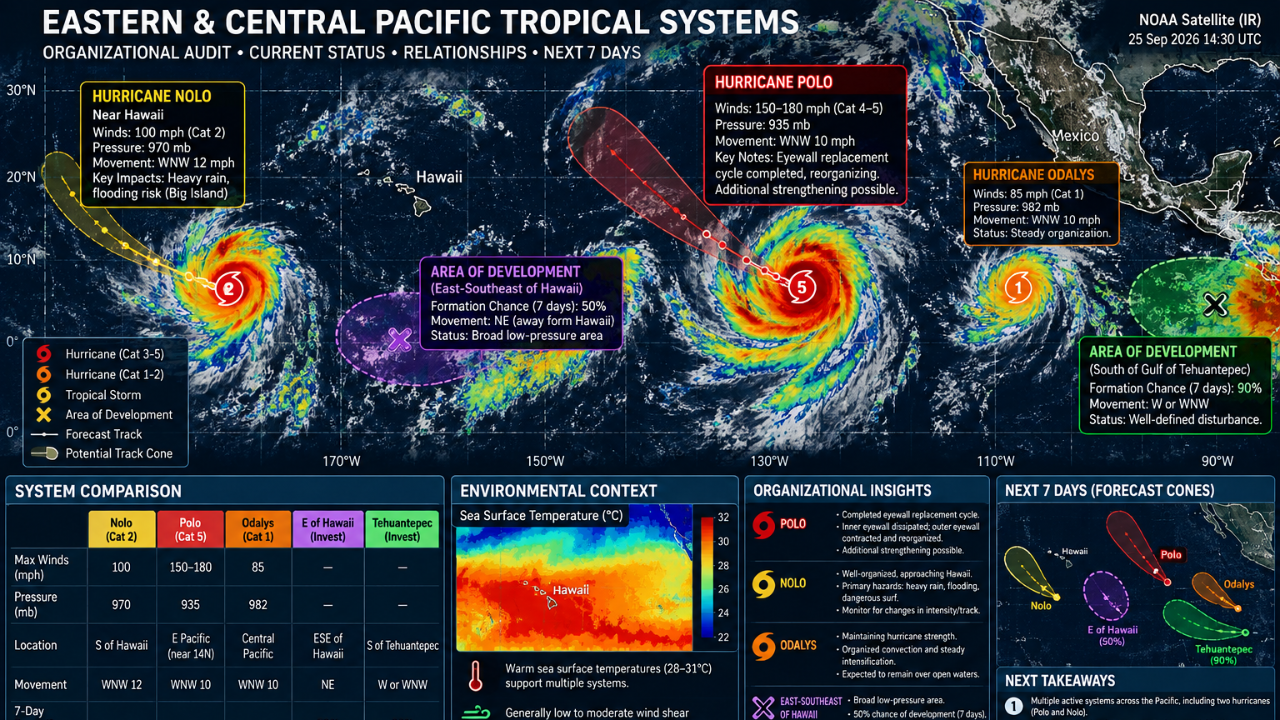
Turner AI Organizational Audit Report
Eastern & Central Pacific Tropical Systems — Hurricane Polo and the Surrounding Pacific Environment
Audit Date: September 25, 2026
Audit Type: Environmental Organization / Dynamic-System Case Study
Primary Focus: Hurricane Polo, Hurricane Nolo, and the surrounding tropical-development environment
Executive Summary
The current Pacific tropical environment provides an unusually valuable Turner AI case study because the scientifically interesting feature is not simply that multiple storms exist simultaneously, nor that Hurricane Polo has reached extreme intensity. The stronger question is how organization is being established, maintained, disrupted, transferred, and re-established across changing environmental conditions.
Current NOAA/NHC information shows several simultaneous tropical systems and development areas across the Eastern and Central Pacific. Hurricane Polo has undergone significant internal structural change, including an eyewall re...
Your AI Worked. But Do You Know Why?
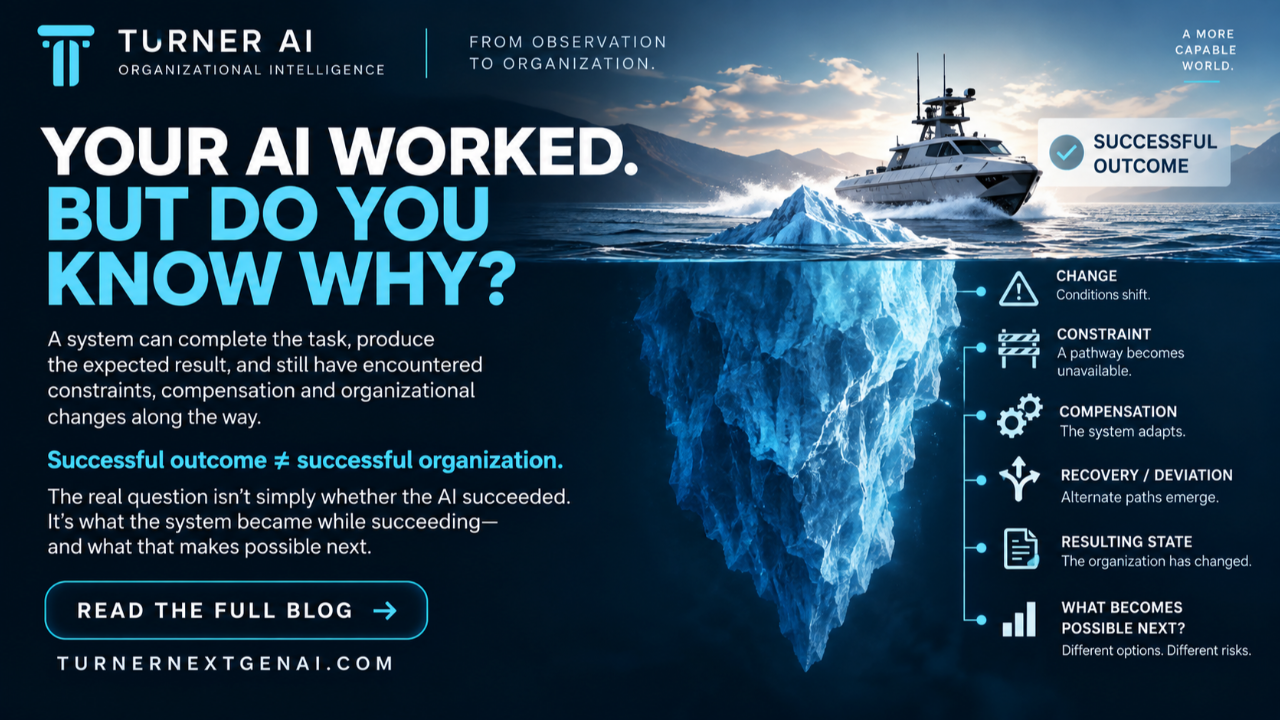
The next challenge in artificial intelligence isn’t simply getting systems to perform. It’s understanding the organization that makes performance possible.
For much of the development of artificial intelligence, success has been relatively easy to define. We gave a system a task and asked whether it could accomplish it. Could the vision model identify the object? Could the robot navigate the room? Could the agent complete the workflow? Could the autonomous system reach its destination?
Those were important questions because, for a long time, simply getting the technology to work was the challenge.
That is changing.
AI systems are becoming capable enough that successful task completion can no longer tell us everything we need to know about the intelligence operating underneath it. A system can produce the expected result while the organization supporting that result is changing, compensating, becoming constrained, or even deteriorating.
In other words, an AI can work without us ...
You Gave Everyone the Same AI. You Didn't Give Them the Same Capability.
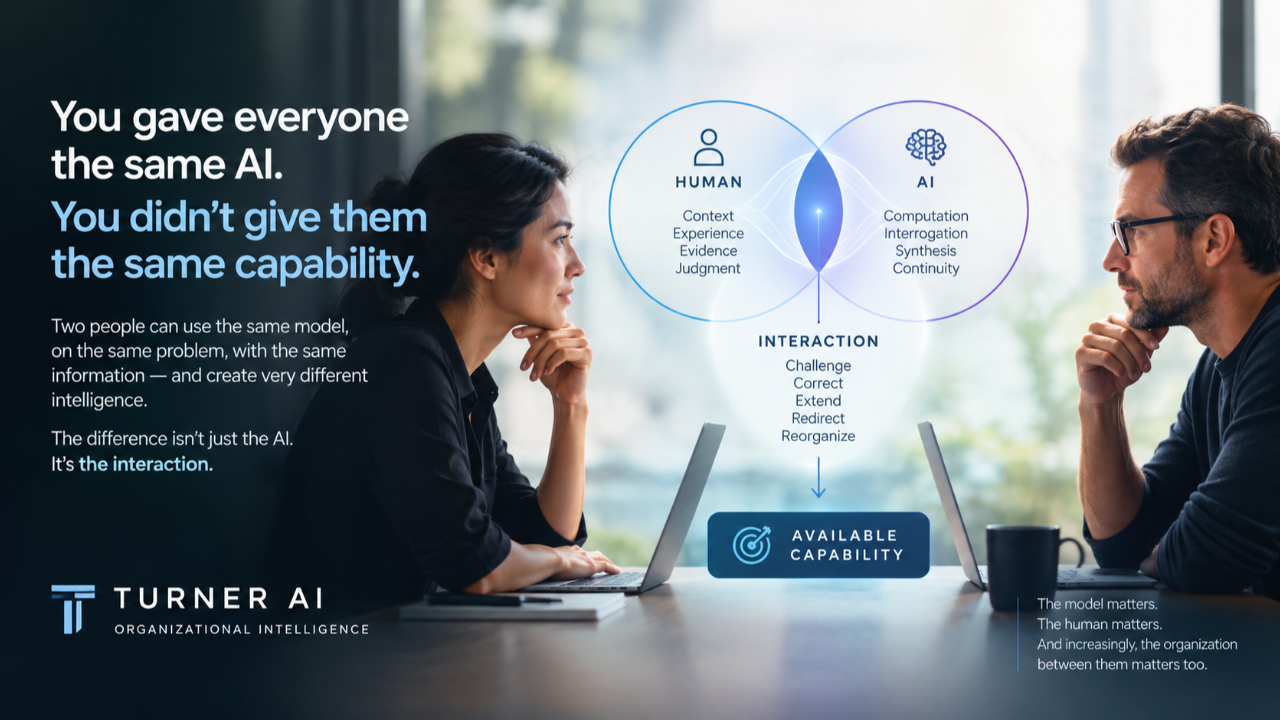
Companies are spending enormous amounts of money putting increasingly powerful artificial intelligence into the hands of their employees. The models are improving, enterprise access is expanding, and AI is being embedded into the software people already use. It is becoming reasonable for a company to say that hundreds or thousands of its employees now have access to essentially the same artificial intelligence.
But that does not mean those employees have access to the same capability.
This is becoming one of the more interesting problems we are examining at Turner AI because it changes where we look for AI capability. We are accustomed to looking inside the model. We benchmark reasoning, retrieval, coding, vision, context, speed and accuracy because those measures tell us something important about what the artificial system can potentially do. Once that system begins interacting with a human, however, the model is no longer operating alone.
Put exactly the same AI in front of two...
Your AI May Be Seeing More Than Your Company Knows How to Use
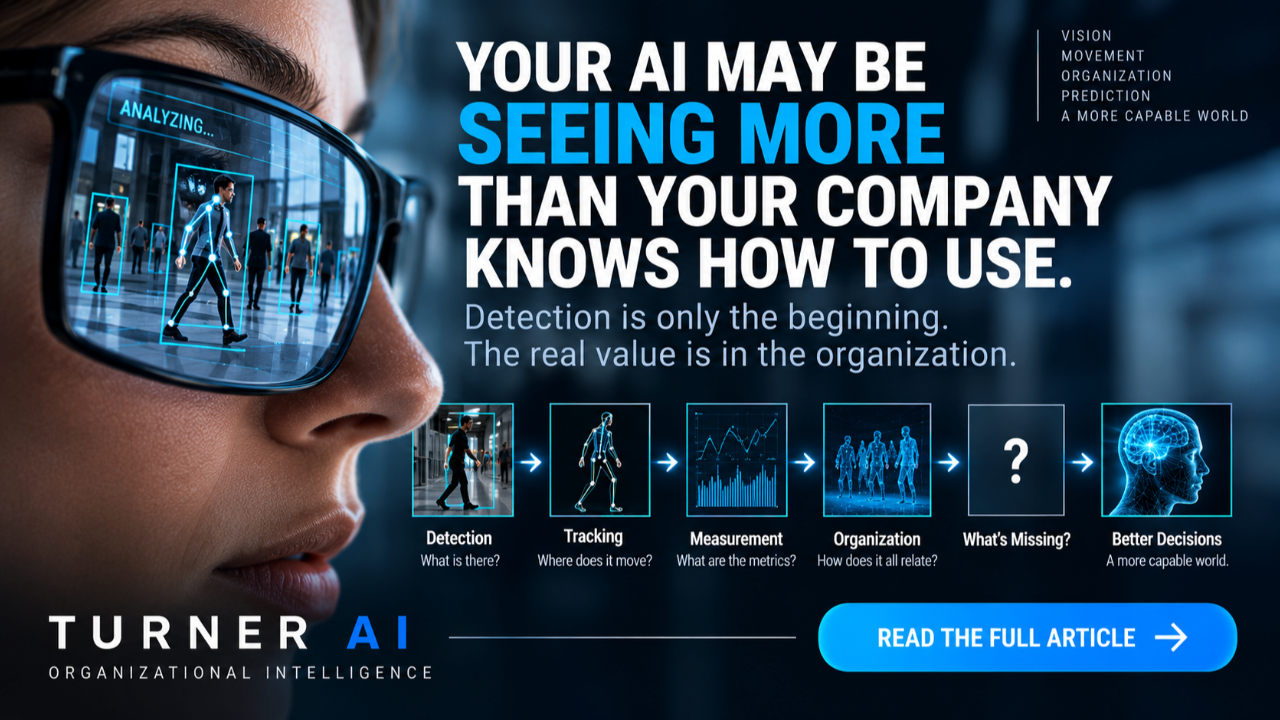
The next opportunity in computer vision may not be seeing more. It may be understanding what the system already sees.
Companies have spent years increasing the ability of artificial intelligence to see. Cameras have become more sophisticated, sensors capture increasingly detailed information, and computer vision models can now identify objects, recognize people, estimate poses, track movement, measure trajectories, classify activities and detect events with remarkable speed. As these capabilities improve, it is easy to assume that greater accuracy in detection automatically produces greater understanding of the environment being observed.
But detection and understanding are not the same computational problem.
A system can correctly identify nearly everything visible within a scene and still fail to understand how those elements are organized in relation to one another, how that organization is changing through time, or why those changes matter to the mission the system is suppose...
Grasping a Cup: Why AI May Be Solving the Wrong Problem
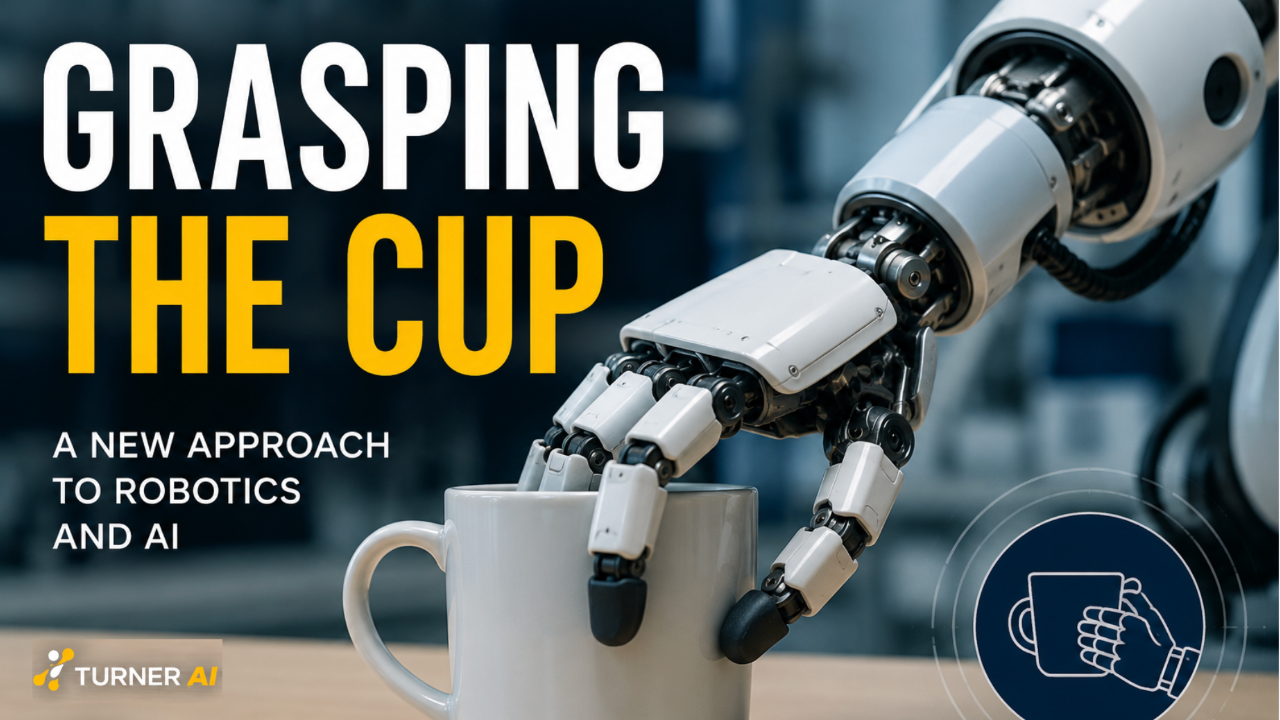
Grasping a Cup: Why AI May Be Solving the Wrong Problem
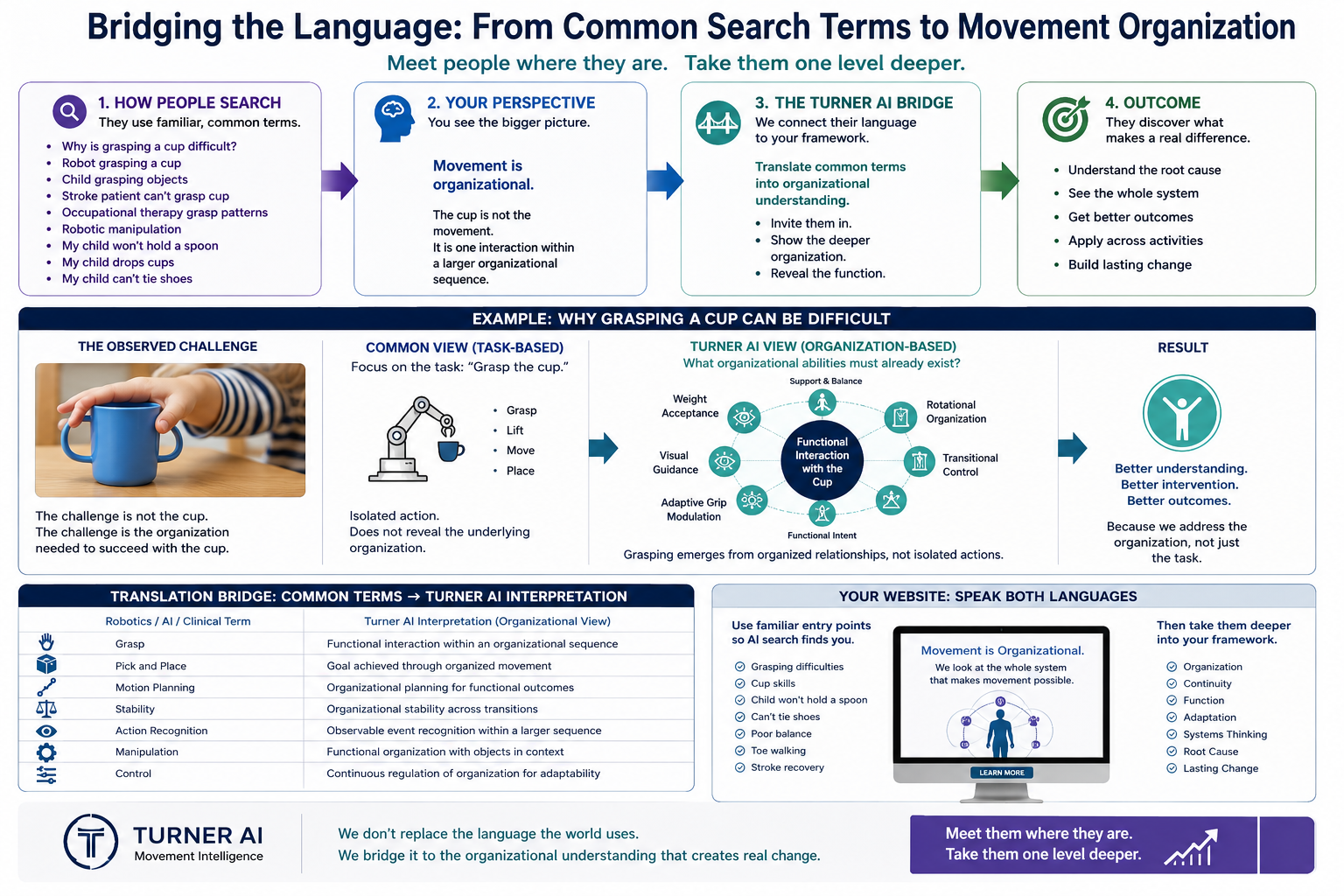 One of the most common benchmark tasks in robotics and embodied AI is grasping a cup.
At first glance, this seems reasonable. A robot must identify the cup, determine its location, calculate the appropriate grip force, lift it without dropping or crushing it, and place it where intended. Success is typically measured by whether the cup is successfully manipulated.
This approach has driven decades of impressive engineering advances.
But there is another way to view the problem.
The Engineering Representation
Current robotics systems often represent the task as a sequence such as:
-
Detect cup
-
Plan grasp
-
Apply grip force
-
Lift
-
Move
-
Place
-
Release
Each step can be measured, optimized, and benchmarked.
This representation has been extremely useful for developing robotic manipulation.
However, it also assumes that grasping is the task.
The Human Representation
Humans rarely think:
"
...
Turner AI: Beyond Pattern Recognition—Computing Organizational Intelligence
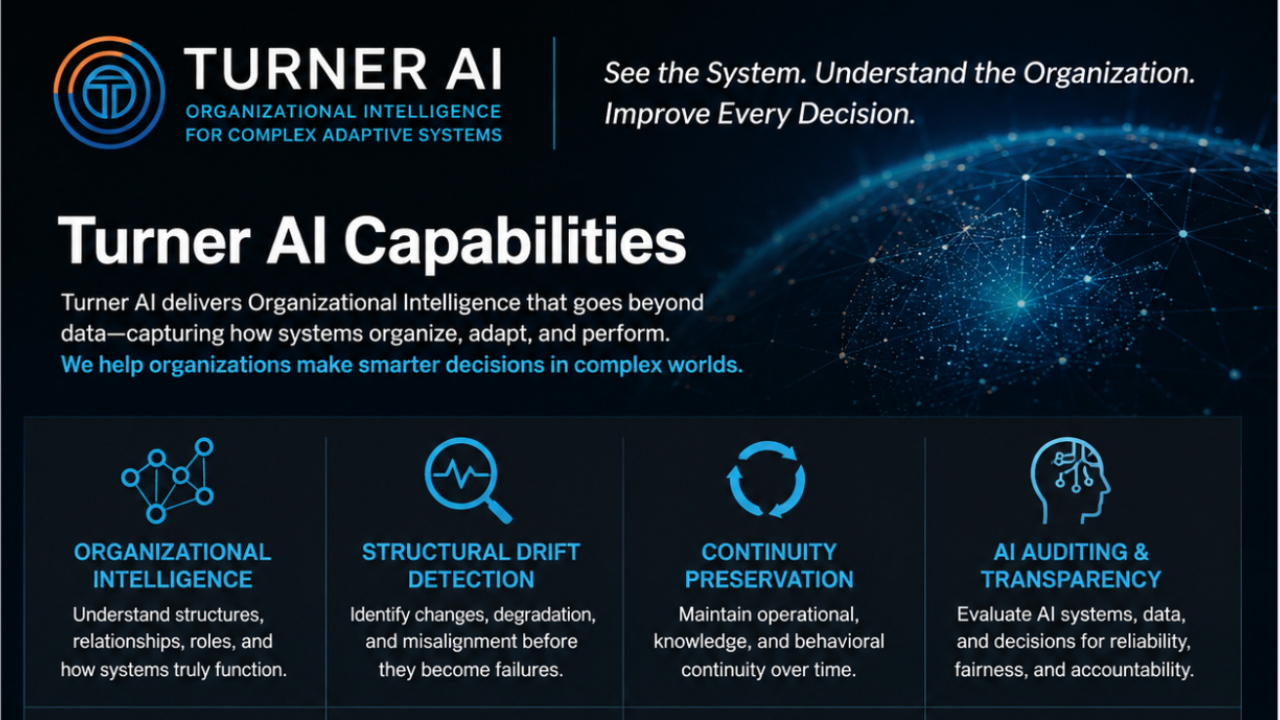
Turner AI: Beyond Pattern Recognition—Computing Organizational Intelligence
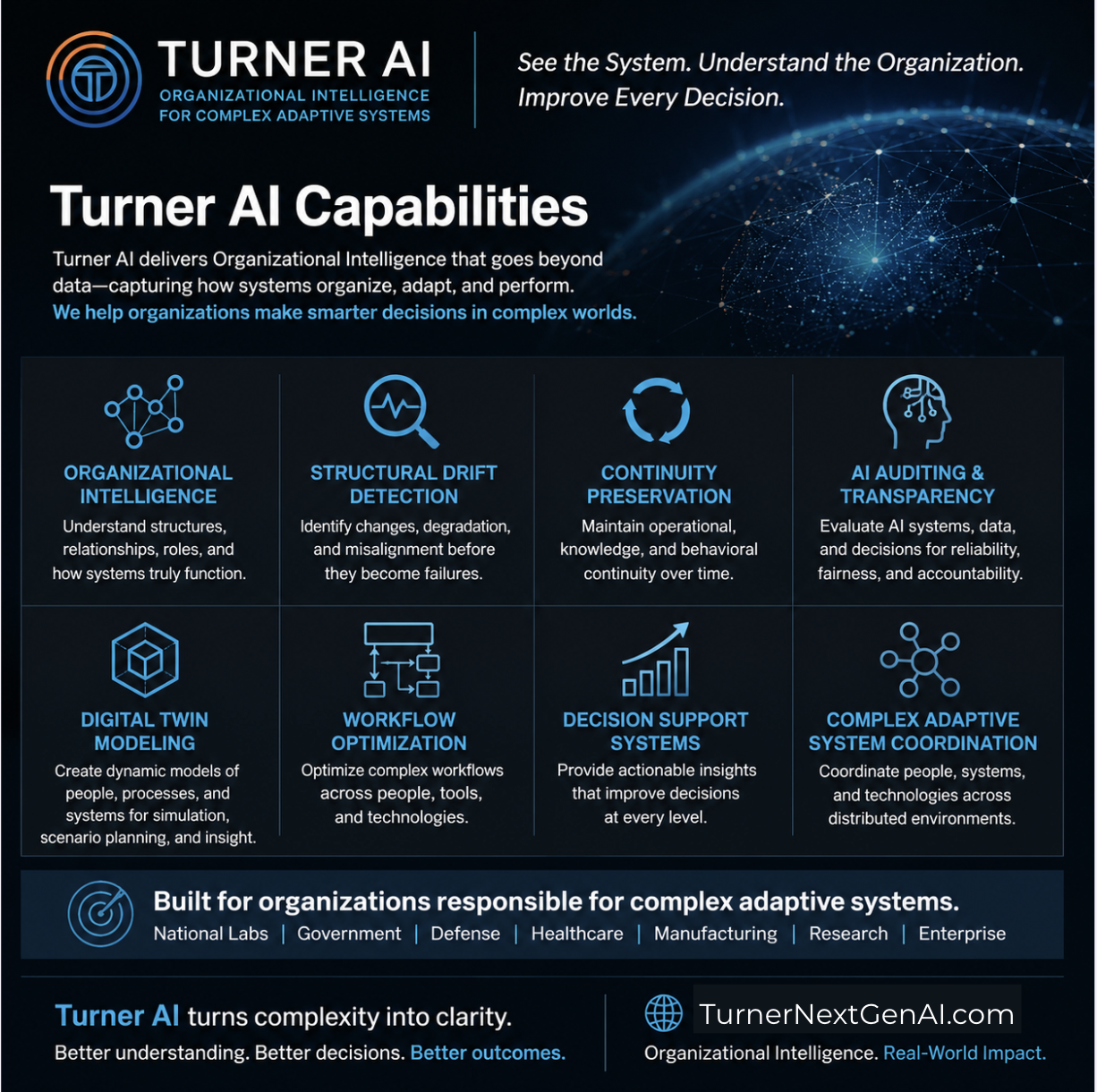
Artificial intelligence has made remarkable advances in recognizing patterns. From computer vision to large language models, today's AI excels at identifying what has happened, classifying observations, and predicting likely outcomes from existing data.
But many of the world's most important problems are not limited by pattern recognition.
They are limited by understanding how complex systems organize themselves.
That distinction is at the heart of Turner AI.
For decades, industries have relied on increasingly sophisticated methods to analyze outputs. In manufacturing, systems monitor production metrics. In healthcare, clinicians evaluate patient outcomes. In robotics, cameras track movement. In enterprise software, AI optimizes individual components. Yet across these domains, a common challenge remains: current systems often optimize local performance while struggling to understand the organizational...
Negotiation Load: A Missing Variable in Intelligence, Adaptation, and System Performance
Negotiation Load: A Missing Variable in Intelligence, Adaptation, and System Performance
Abstract
Most models of intelligence, performance, and adaptation focus on resource availability. Systems are evaluated according to available energy, computational capacity, personnel, capital, bandwidth, or time.
However, resource availability alone does not explain system behavior.
Two systems with identical resources may exhibit dramatically different levels of performance, adaptability, and resilience.
This paper introduces the concept of Negotiation Load (NL): the hidden organizational cost required before action can occur.
Negotiation Load represents the amount of internal processing, stabilization, conflict resolution, uncertainty management, compensation, and risk evaluation required prior to executing a task.
As systems mature, negotiation load decreases.
As systems become injured, degraded, uncertain, or disorganized, negotiation load increases.
Negotiation Load may therefore...
Agents Are Not Intelligence: Why the AI Industry May Be Solving the Wrong Problem
Turner NextGen AI
The artificial intelligence industry has entered what appears to be the "Age of Agents."
Every major technology company is now promoting:
-
AI Agents
-
Autonomous Agents
-
Personal Agents
-
Enterprise Agents
-
Multi-Agent Systems
The promise is simple:
An agent will schedule meetings, answer emails, coordinate tasks, manage workflows, interact with software, and eventually act on behalf of the user.
While these capabilities may provide substantial value, they raise an important question:
Are we building intelligence, or are we building automation?
The distinction matters.
Because the future of AI may depend on understanding the difference.
The Current Agent Explosion
Over the past several years, artificial intelligence has made enormous advances in:
-
language generation
-
coding
-
summarization
-
search
-
image generation
However, progress toward Artificial General Intelligence (AGI) has proven far more difficult ...